
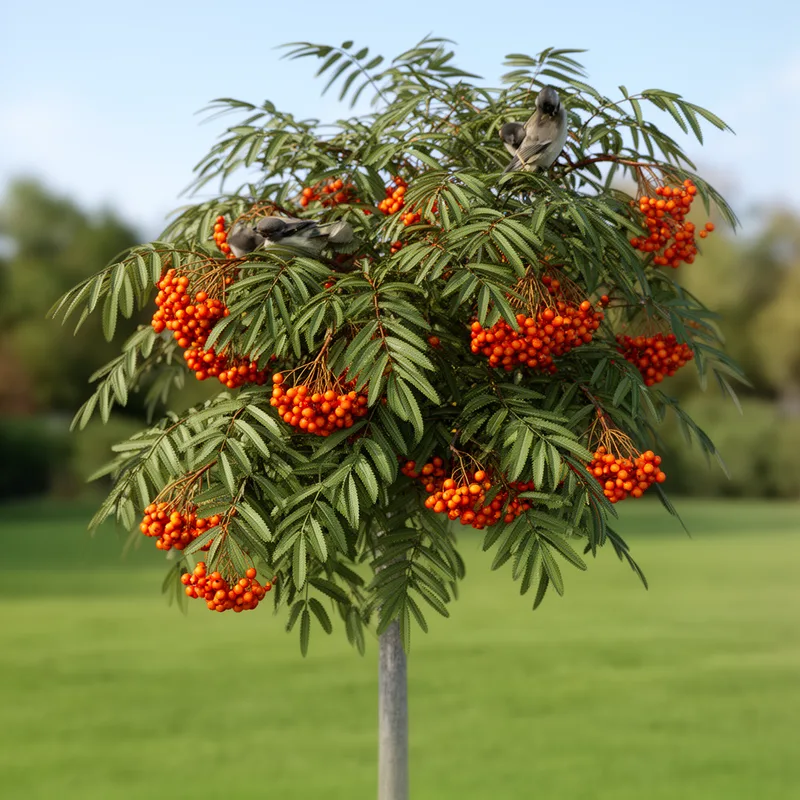
Sorbus aucuparia
- noun
- UK
- Birds are often attracted to the orange-red berries of the Sorbus aucuparia.
Examples
-
Many traditional landscapes across Europe feature the Sorbus aucuparia as an ornamental tree.
-
The Sorbus aucuparia adds a splash of bright color to gardens in autumn.
-
The Sorbus aucuparia is commonly found in Europe.
-
Many birds enjoy the berries of the Sorbus aucuparia.
-
The Sorbus aucuparia is known for its striking clusters of orange-red berries that attract many birds.
-
In the countryside, the Sorbus aucuparia can often be seen standing tall with its pinnate leaves.
-
During autumn, the vibrant orange-red berries of the Sorbus aucuparia provide a beautiful contrast against the changing leaves.
Synonyms

 1
8.6
1
8.6

A small tree from Europe and Asia with many small leaves and groups of orange-red berries

A small tree from Europe and Asia with leaves made of many small leaflets and clusters of orange-red berries

A small tree with white flowers and red berries that birds eat

A tree with divided leaves, white spring flowers, and red or orange berries that attract birds
Surface Forms
Morphology
Sorbus + aucuparia
This is a Latin scientific binomial (genus + species) rather than a compositional English phrase; the parts are taxonomic labels (Sorbus) and a Latin epithet (aucuparia) that a B1 learner would not recognize or map onto 'rowan/mountain ash'. Although the name is consistent cross-linguistically, its meaning is not derivable from ordinary English vocabulary, so learners who know the surface constituents would not be able to infer the common-tree meaning.
Etymology
Sorbus aucuparia comes from Latin names. Sorbus is the old name for the rowan tree and aucuparia means 'to catch birds' because its bright orange-red berries attract birds, so the name describes a tree whose fruit draws birds.