
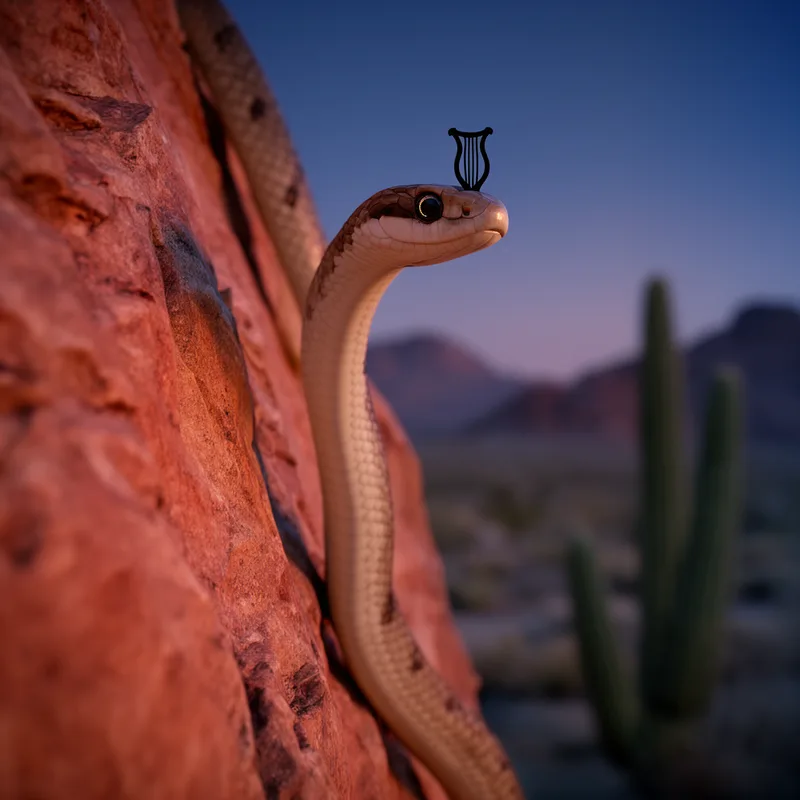
Sonoran lyre snake
- noun
- /səˈnɔrən laɪər sneɪk/
- Specialized
- You can identify a Sonoran lyre snake by the distinctive lyre-shaped pattern on its head.
Examples
-
Unlike other desert snakes, the Sonoran lyre snake is skilled at climbing rocky slopes and cliffs.
-
The Sonoran lyre snake is most active at night during the hottest months of the year.
-
The Sonoran lyre snake is often found in Arizona.
-
Many Sonoran lyre snakes inhabit the desert areas.
-
You can identify a Sonoran lyre snake by the distinctive lyre-shaped pattern on its head.
-
Unlike other desert snakes, the Sonoran lyre snake is skilled at climbing rocky slopes and cliffs.
-
The Sonoran lyre snake is most active at night during the hottest months of the year.
Synonyms
A desert snake from southwestern North America that is not venomous and has a V-shaped mark on its head
Surface Forms
Morphology
The phrase is a literal compositional name: 'Sonoran' (from Sonora) + 'lyre' (the lyre-shaped marking) + 'snake' (reptile), so a learner who knows those constituents can infer it is a snake from the Sonora region with lyre-shaped markings. Note that 'lyre' is less frequent, so transparency depends on knowing that constituent, but given that knowledge the compound is straightforward and non-idiomatic.
Etymology
Sonoran lyre snake gets its name from the 'Sonora' region and from a dark mark on its head that looks like a small lyre, an old string instrument. So the name tells you both where the snake lives and the lyre-shaped head pattern that helps people identify this type of snake.

