
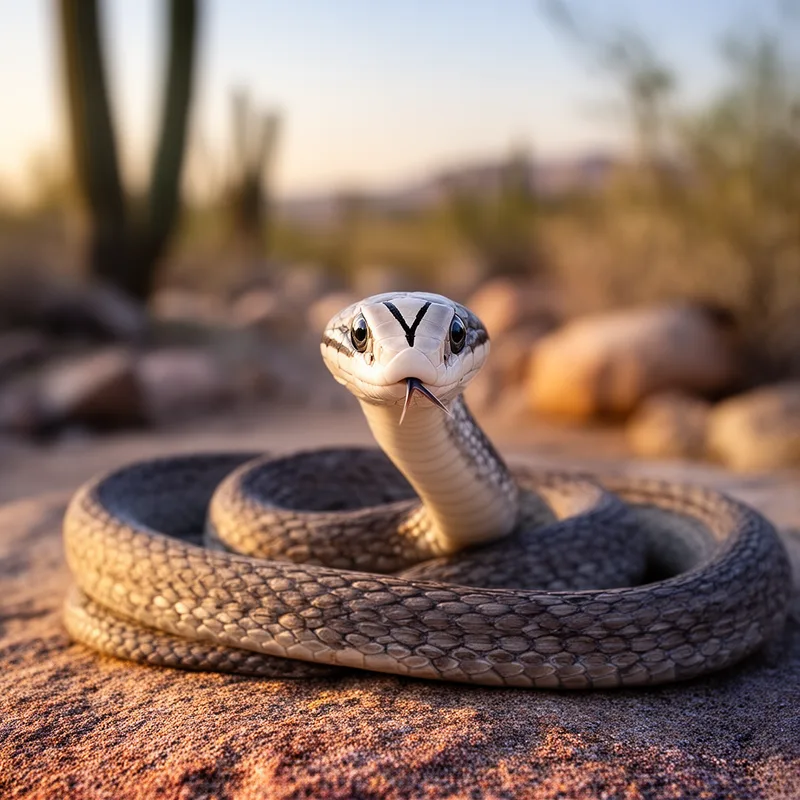
Trimorphodon lambda
- noun
- /traɪˈmɔrfədɒn ˈlæmbdə/
- Specialized
- The Trimorphodon lambda is well adapted to the rocky deserts of Arizona and Sonora.
Examples
-
Wildlife guides describe the Trimorphodon lambda as a nonvenomous species with a distinct V-shaped mark on its head.
-
Researchers observed that Trimorphodon lambda hunts primarily at night.
-
The Trimorphodon lambda is commonly found in Arizona.
-
Many people are fascinated by the Trimorphodon lambda due to its unique coloration.
-
The Trimorphodon lambda blends seamlessly into its desert surroundings, making it difficult to spot.
-
In the warm nights of the Sonoran Desert, the Trimorphodon lambda is often seen gliding over the rocky terrain.
-
Due to its nonvenomous nature, the Trimorphodon lambda is a popular subject for wildlife enthusiasts.
Synonyms
A snake that lives in deserts of southwestern North America with a lyre-shaped mark on its head
Surface Forms
Morphology
Trimorphodon + lambda
The first constituent 'Trimorphodon' explicitly names a snake genus, so a learner who knows that term can infer the phrase refers to a kind of Trimorphodon (i.e., a specific snake). However, the second element 'lambda' is an arbitrary species epithet (and here listed as uninterpretable), and understanding that two-word Latin/Greek binomials denote species requires extra biological knowledge. Because part of the meaning (type of snake) is recoverable from the constituents but the full taxonomic function of the phrase is not transparently derivable for a typical B1 learner, it is only partly transparent.
Etymology
Trimorphodon lambda may come from Greek parts: tri- meaning 'three', morpho- meaning 'shape', and -don meaning 'tooth', because the snake has teeth of different shapes. The second word lambda is the Greek letter that looks like a 'V', like the mark on the snake's head, so the full name points to its different teeth and the V-shaped head mark.

