
Sienese


 1
7.8
1
7.8
- adjective
- /siˈiːniːz/
- The illustrations, sketched by a fast, concise hand, stand out for their strikingly smooth style, unusual in the Sienese production of the time, and a quality matched by the spontaneity of the narration and an uncommonly flowing hand.
Examples
-
The pictures, partly watercolor drawings and partly proper illuminations, were made by an extremely sophisticated Sienese artist who was heavily influenced by Transalpine miniaturists and active from around 1290 through the next decade.
Blog text (16) -
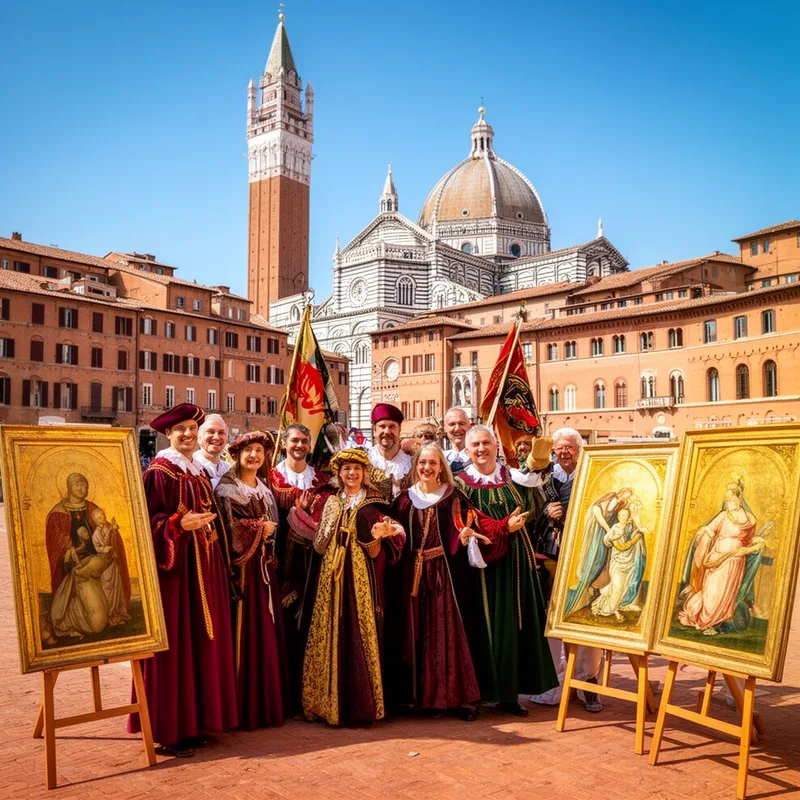
Many famous Sienese artists contributed to the rich cultural heritage of Tuscany during the Renaissance.
-
Typical of landscapes in Sienese paintings, this one uses the hill to emphasize Saul's collapse by kind of dipping down behind him.
-
It was carved in the 13th century by a member of the Sienese school, and it is on display in Volterra's Pinacoteca e Museo Civico.
Blog text (17) -
The Sienese artist envisioned Athos as a living organism, his rivers and torrents constituting the circulatory system and converging in the bowl in his left hand.
Academic text (2005) -
The architecture of the cathedral in Siena is a prime example of Sienese style, showcasing intricate Gothic details.
-
You can find many Sienese paintings in the local museum, reflecting the unique artistic traditions of the region.
How Specific

Surface Forms
Morphology
Sienese = Siena (transparent) = Siena + ese
Formed by the productive demonym/relational suffix '-ese' added to the place name 'Siena', so the meaning 'relating to Siena' is directly derived.
Etymology
Sienese comes from the city name Siena and the ending -ese, which means 'from' or 'connected to' and you see it in words like Chinese and Japanese. So Sienese means 'relating to Siena', its people, art, or culture.