

Setaria italica stramineofructa
- noun
- Specialized
- The golden hues of Setaria italica stramineofructa make it easy to distinguish at harvest.
Examples
-
Farmers in the region cultivate Setaria italica stramineofructa for its high yield and drought resistance.
-
Researchers are studying Setaria italica stramineofructa to improve millet crop resilience.
-
The Setaria italica stramineofructa is commonly used in traditional dishes.
-
Farmers in Asia grow Setaria italica stramineofructa for its nutritious grains.
-
Farmers in the region cultivate Setaria italica stramineofructa for its high yield and drought resistance.
-
Researchers are studying Setaria italica stramineofructa to improve millet crop resilience.
-
The golden hues of Setaria italica stramineofructa make it easy to distinguish at harvest.
Synonyms

A plant with yellow grains and large hanging seed heads grown for food and animal feed
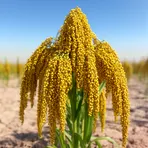
A grain plant with yellow seeds in large hanging spikes

A grass plant that tolerates drought and is grown for small seeds and animal feed

A rough grass that grows in dry places and is grown for grain and animal feed
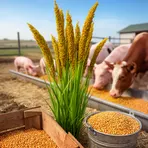
A grass that grows once a year for its grain and is used as animal feed
Surface Forms
Morphology
Setaria + italica + stramineofructa
The name is a botanical Latin binomial composed of a genus (Setaria) and descriptive Latin epithets; the literal sense (a grass/foxtail millet variety with a particular, straw‑colored fruit and likely an Italian connection) is compositionally derivable if one knows Latin roots. However, the epithets are not English lexical items and require knowledge of Latin morphology/terminology that a B1 learner typically lacks, so the meaning is only partially accessible.
Etymology
Setaria italica stramineofructa gets its name from Latin parts: Setaria (from 'bristle'), italica ('Italy'), and stramineofructa ('straw-coloured grain'). So the name creates a picture of a bristle-like plant with yellow, drooping grains, which fits this type of foxtail millet.

