

Senecio jacobaea
- noun
- Specialized
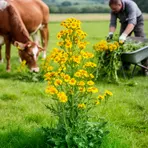
- Senecio jacobaea is often found growing in pastures, where its bright yellow flowers are easily spotted.
Examples
-
Farmers are advised to remove Senecio jacobaea from grazing areas due to its toxicity to livestock.
-
The rapid spread of Senecio jacobaea has made it a troublesome weed in many European countries.
-
The Senecio jacobaea is often found in fields and along roadsides.
-
Farmers consider Senecio jacobaea an obnoxious weed.
-
Farmers are advised to remove Senecio jacobaea from their fields because it is toxic to cattle when consumed.
-
In the summer, Senecio jacobaea blooms with bright yellow flowers that attract a variety of insects.
-
To prevent livestock poisoning, it is crucial to control the spread of Senecio jacobaea in pastures.
Synonyms
 1
8.6
1
8.6

A wild plant with yellow daisy-like flowers that is poisonous to farm animals

A common European weed with yellow flowers that is poisonous to cattle if eaten

A common weed with yellow daisy-like flowers that can poison cattle
Surface Forms
Morphology
Senecio + jacobaea
This is a Latin binomial (taxonomic) name, where the parts function as arbitrary scientific labels rather than compositional English words; knowing 'Senecio' as a genus and an undefined 'jacobaea' does not allow a B1 learner to infer the meaning 'ragwort' or its properties. Such species names are language-neutral labels and are not transparently built from common English vocabulary, so the meaning is unpredictable without prior exposure or botanical knowledge.
Etymology
Senecio jacobaea paints a simple picture: Senecio comes from the old word 'senex' meaning 'old man' because the white seed tufts look like an old man's beard, and jacobaea is an old name linked to 'Jacob' used for this plant. So, think of a yellow daisy that later makes a white 'beard'—the common weed 'ragwort' that can be poisonous to animals.