
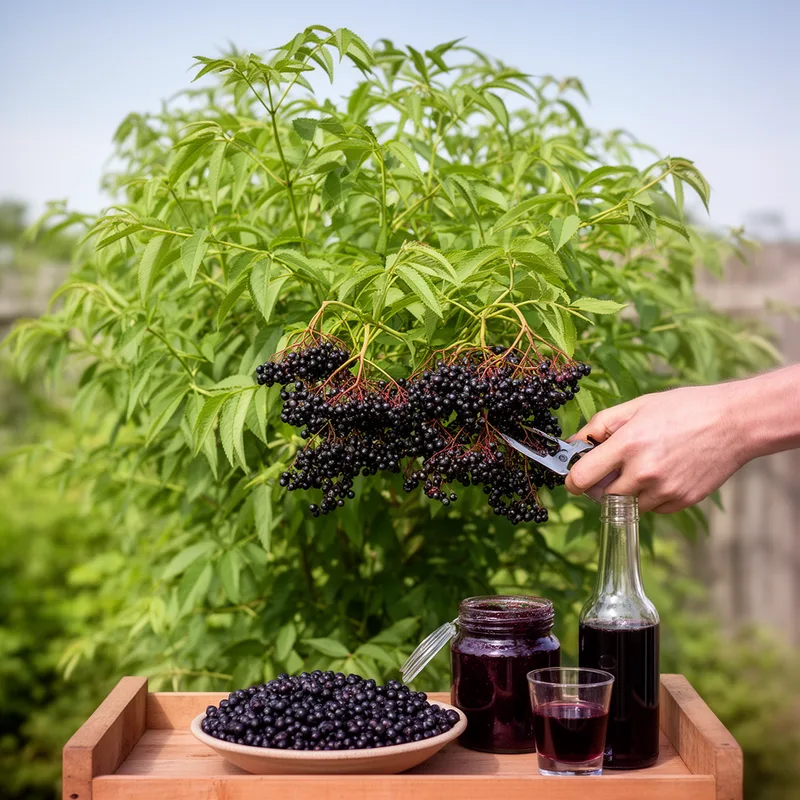
Sambucus canadensis
- noun
- /sæmˈbjuːkəs kænəˈdɛnsɪs/
- Specialized
- Many traditional recipes for elderberry wine call specifically for Sambucus canadensis fruit.
Examples
-
Botanists studied the habitat range of Sambucus canadensis throughout eastern North America.
-
The Sambucus canadensis plant thrives in wetland areas.
-
The Sambucus canadensis in our backyard produces clusters of edible berries each summer.
-
Many people enjoy making wine from Sambucus canadensis berries.
-
The common elder, Sambucus canadensis, bears tart, edible, purplish-black berries that are often used in making wild jams and jellies.
-
People often gather Sambucus canadensis berries in the late summer to make delicious elderberry wine.
-
The flowers of Sambucus canadensis can be harvested to make a soothing herbal tea.
Synonyms
A North American bush that people use to make jam and wine from its purple-black berries

A shrub with clusters of dark purple berries used to make wine and jam

A shrub with clusters of dark purple berries used to make jam, syrup or wine
Surface Forms
Morphology
This is a Latin binomial formed compositionally from the genus name 'Sambucus' and the specific epithet 'canadensis' meaning 'from Canada', so a learner who knows both constituents can infer it denotes the Sambucus species originating from Canada/North America. The pattern (genus + origin-based epithet) is a regular taxonomic convention, making the meaning predictable rather than idiomatic.
Etymology
Sambucus canadensis is the scientific name for the North American elderberry. The first part, Sambucus, comes from an old word for the elder tree, and the second part, canadensis, simply means 'from Canada' or 'from North America', so the name literally points to the elder found in that region.

