
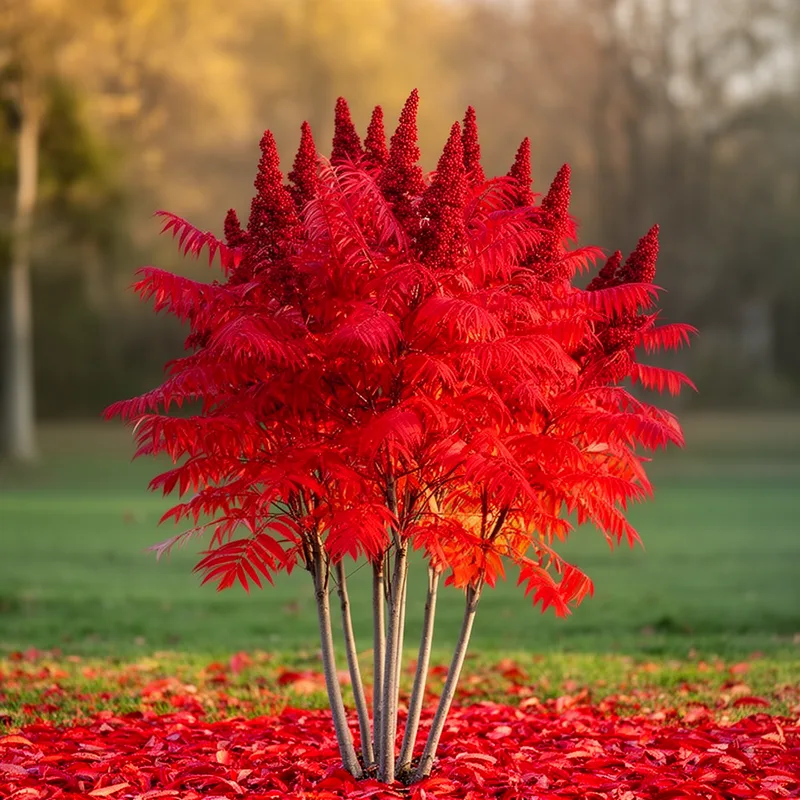
Rhus typhina
- noun
- /rəs ˈtɪfɪnə/
- Specialized
- The vibrant red leaves of Rhus typhina stand out beautifully every autumn.
Examples
-
Many birds are attracted to the crimson berries of Rhus typhina in the winter months.
-
Gardeners often plant Rhus typhina for its ornamental foliage and wildlife value.
-
The Rhus typhina is often used in landscaping.
-
In autumn, the Rhus typhina displays stunning red leaves.
-
Gardeners often plant Rhus typhina for its ornamental foliage and wildlife value.
-
Many birds are attracted to the crimson berries of Rhus typhina in the winter months.
-
In autumn, the Rhus typhina displays stunning red leaves.
Synonyms

A small tree or large bush with bright red leaves and sour red berries in autumn
A North American shrub or small tree with groups of bright red berries

A small tree or bush with leaves that turn bright red in autumn and clusters of red berries

A small tree or shrub with velvety branches, bright red autumn leaves, and red berries
Surface Forms
Morphology
Rhus + typhina
This is a Linnaean binomial: while 'Rhus' identifies the genus (sumac), 'typhina' is a Latin species epithet with no transparent, standalone lexical meaning for a B1 learner. Scientific names act as arbitrary labels rather than compositional phrases, so knowing the constituent words would not let a learner infer the detailed botanical meaning.
Etymology
Rhus typhina comes from old words: Rhus means 'sumac' and typhina may come from a word for 'fuzzy' or 'tuft'. The name paints a picture of a sumac with fuzzy twigs and bright red berry clusters, which is why it fits this small tree.

