
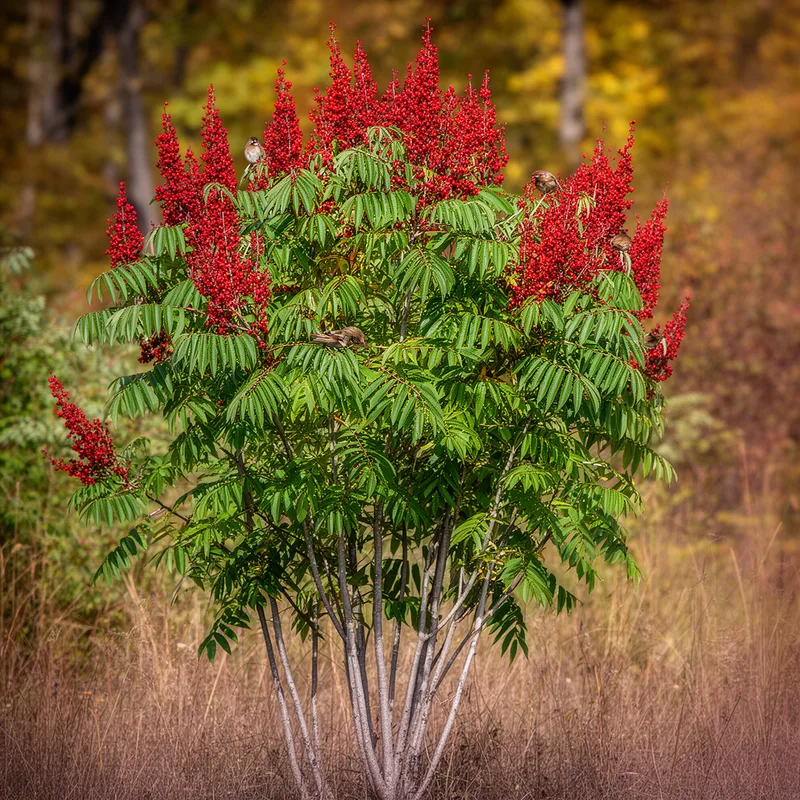
Rhus copallina
- noun
- /rəs ˌkɒpəˈliːnə/
- Specialized
- We identified the shrub as Rhus copallina by its distinctive winged leaf stalks.
Examples
-
The Rhus copallina in our backyard attracts a wide variety of birds in the fall.
-
Native Americans historically used parts of Rhus copallina for medicinal purposes.
-
The Rhus copallina is often used in landscaping.
-
Have you seen a Rhus copallina growing near the river?
-
The Rhus copallina in our backyard attracts a wide variety of birds in the fall.
-
We identified the shrub as Rhus copallina by its distinctive winged leaf stalks.
-
Native Americans historically used parts of Rhus copallina for medicinal purposes.
Synonyms

A small bush with green summer flowers and bright red berries that grows in eastern North America

A low bush from eastern North America with divided leaves and clusters of red berries that attract birds

A shrub from eastern North America with red berries and leaves that turn bright red in fall

A common shrub from eastern North America with smooth, waxy leaves and clusters of red berries
A common harmless shrub from eastern North America with red berries
A small bush with shiny leaves and groups of red berries that is not poisonous

A shrub from eastern North America that is not poisonous with waxy leaves and clusters of red berries
Surface Forms
Morphology
Rhus + copallina
This is a Latin binomial: 'Rhus' names the genus (sumacs), so a learner who knows 'Rhus' could infer it is a type of sumac/shrub, but the specific epithet 'copallina' is not a common English word and conveys no clear meaning to a B1 learner. Botanical Latin epithets are largely opaque without specialist knowledge, so the overall phrase is only partly predictable from its parts.
Etymology
Rhus copallina is a plant name made of two parts. Rhus is the old name for the 'sumac' group and copallina may come from 'copal', a sticky resin, so the name helps you picture a sumac shrub with sticky sap and bright red berries.

