
Rhus glabra
- noun
- /rəs ˈɡlæbrə/
- Specialized
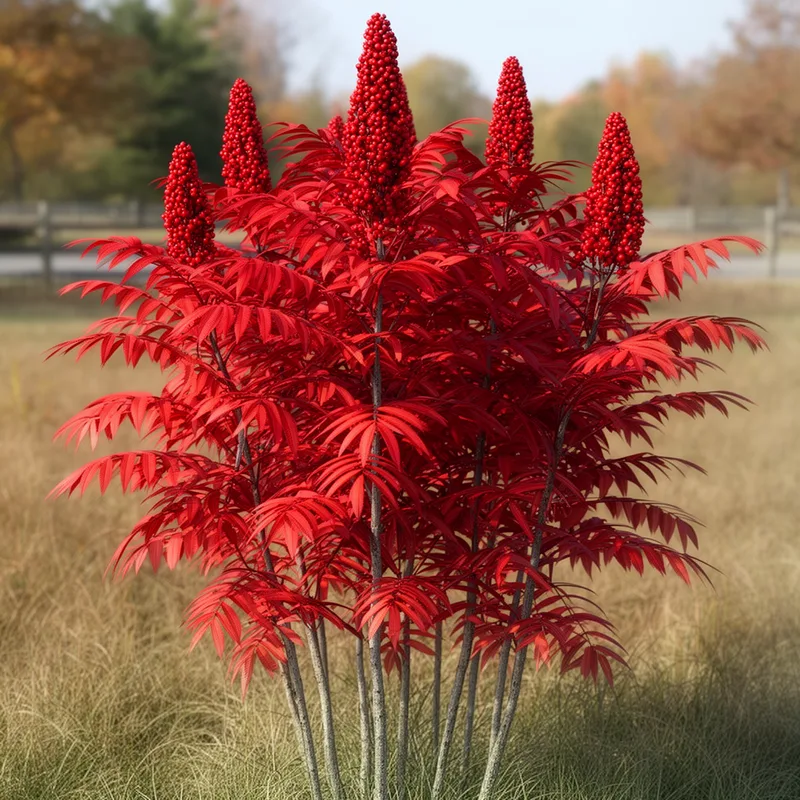
- The leaves of Rhus glabra turn bright red in the fall, making it a popular ornamental plant.
Examples
-
Rhus glabra thrives in open fields and along roadsides throughout eastern North America.
-
Native Americans used the berries of Rhus glabra to make a refreshing beverage.
-
The Rhus glabra is often found in dry, sandy soils.
-
Many birds are attracted to the red berries of Rhus glabra.
-
Rhus glabra is commonly found in the wild, often growing in areas with full sunlight.
-
Historically, Rhus glabra was used by local tribes for medicinal purposes due to its berries.
-
You can identify Rhus glabra by its distinctive smooth leaves and clusters of red berries.
Synonyms

A common shrub from eastern North America with smooth, waxy leaves and clusters of red berries
Surface Forms
Morphology
Rhus + glabra
The item is a Latin binomial (genus + specific epithet), so a learner who knows 'Rhus' can infer this names a species of sumac, but the specific epithet 'glabra' is not an English word and is not listed in the provided dictionary entry. Because 'glabra' is Latin (meaning 'smooth' or 'hairless') the full descriptive meaning ('smooth sumac') requires botanical/Latin knowledge beyond a B1 learner's expected vocabulary.
Etymology
Rhus glabra is the scientific name for the shrub called 'smooth sumac'. Rhus is the old word for sumac and glabra means 'smooth', so the name points to its smooth, hairless leaves and stems and explains why people call it the smooth sumac.

