

Protoctista
- noun
- /ˌproʊtoʊkˈtɪstə/
- Archaic
- In some classification systems, Protoctista is recognized as a distinct kingdom separate from plants and animals.
- Protoctista kingdom
Examples
-
Whittaker was particularly critical of Copeland's decision to include the fungi, red and brown algae, and numerous groups of microscopic eukaryotes in the kingdom Protoctista.
Academic text (2012) -
According to Whittaker, "The kingdom Protoctista seems more a product of taxonomic definitions than a grouping of organisms with coherent meaning or a common evolutionary theme" (Whittaker 1957, p. 536).
Academic text (2012) -
From Whittaker's perspective, Copeland's kingdom Protoctista badly failed this criterion.
Academic text (2012) -
Copeland chose to group the fungi with other "lower" eukaryotic organisms that lacked tissues in his kingdom Protoctista.
Academic text (2012) -
At present, there is clear evidence for fusion of cellular genomes for only one of their five kingdoms, the so-called Protoctista, which no serious biologists accept as a sensible group because it is undoubtedly polyphyletic.
Academic text (2003) -
According to Whittaker, the evidence against this earlier claim undercut both the traditional grouping of fungi within the plant kingdom and Copeland's decision to combine the fungi with various algae in his kingdom Protoctista.
Academic text (2012) -
Combining the fungi, various algae, protozoans, slime molds, and other organisms that lacked true tissues made the kingdom Protoctista very heterogeneous.
Academic text (2012) -
In place of the Protoctista, Whittaker (1959) now proposed a purely unicellular kingdom, Protista—an idea that he attributed to Ernst Haeckel.
Academic text (2012) -
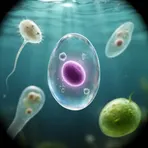
The kingdom Protoctista includes organisms such as protozoa and various algae.
-
Scientists classify certain simple organisms within the biological kingdom Protoctista.
Synonyms
 1
8.9
1
8.9

A mostly single-celled living thing with a nucleus, like protozoa or some algae, different from plants, animals and fungi

A group of mainly single-celled living things like algae and protozoa that are not plants or animals

A group of mostly single-celled living things with cells that have a nucleus, like slime molds and some algae
Compounds
- Specialized
A group of mainly single-celled living things like algae and protozoa that are not plants or animals
Surface Forms
Morphology
Protoctista = proto + ctist
This is a Latinized scientific coinage with a recognizable proto- element, but the remaining stem is not a transparent English base, so the meaning is not recoverable from the parts for an average learner.
Etymology
Protoctista comes from Greek parts proto- meaning 'first' and ktistos meaning 'created'. The proto- part is the same as in prototype, so think 'first created' to remember that this group contains many early or simple organisms, like single-celled protozoa and algae, that are not true plants or animals.