

Pneumocystis
- proper noun
- /njuːməˈsɪstɪs/
- Specialized
- He learned that Pneumocystis is a significant threat to individuals with compromised health.
- Pneumocystis jirovecii
Examples
-
PCP = Pneumocystis jirovecii
Academic text (2007) -
Table 1. Characteristics of San Francisco General Hospital staff in a study of antibody responses to Pneumocystis jirovecii, San Francisco, California, USA, 2007-2009* TABLE #
Academic text (2013) -
In a previous cross-sectional study, we showed that clinical staff working in a hospital had significantly higher antibody levels than nonclinical staff to Pneumocystis jirovecii.
Academic text (2013) -
Concomitant involvement by Pneumocystis jirovecii and Cytomegalovirus was seen in five patients, the diagnosis made only at postmortem.
Academic text (2007) -
Pneumocystis jiroveci (PCP)
Blog text (29) -
Bronchoalveolar lavage diff-quick stain and silver stain were positive for Pneumocystis jiroveci (Figure 2).
Academic text (2007) -
In patients with weakened immune systems, Pneumocystis jirovecii can lead to severe pneumonia.
-
The doctor diagnosed her with an infection caused by Pneumocystis jirovecii after observing her symptoms.
Compounds

- Specialized
 2
7.7
2
7.7

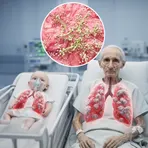
A serious lung infection caused by a fungus that affects babies and people with weak immune systems

- Specialized
A fungus that infects the lungs of animals like mice and rats and helps scientists study lung disease
- Archaic
A lung infection caused by a fungus that affects babies and people with weak immune systems
Surface Forms
Morphology
Pneumocystis = pneumo + cystis
As a taxonomic/proper name composed of Greek combining forms referring to 'lung' and 'sac', the construction is specialized and not transparently meaningful to general learners.
Etymology
Pneumocystis breaks into pneumo- ('lung') and -cystis ('sac'), the same parts you see in pneumonia and cyst. That's why this fungus has a name that points to small sac-like structures in the lungs and to the serious lung infections it can cause.