

Pinus pungens
- noun
- /ˈpaɪnəs ˈpʌŋɡənz/
- Specialized
- The Pinus pungens thrives on rocky slopes in the Appalachian Mountains.
Examples
-
The Pinus pungens is known for its distinctive, dark brown flaking bark and sharp cones.
-
Botanists studied the unusual thorn-tipped cones of the Pinus pungens specimen.
-
Fire has an important role in the regeneration of Pinus pungens forests.
-
The Pinus pungens is often found in rocky areas.
-
Have you ever seen a Pinus pungens up close?
-
In the cool mountain air, the Pinus pungens stands out with its two needle-like leaves per bundle.
-
Hikers enjoy the scenery provided by the Pinus pungens, which thrives on rocky slopes.
Synonyms

A small pine tree with two needles together, peeling brown bark, and cones with sharp points
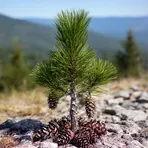
A small pine tree with two long needles, dark peeling bark, and cones with sharp tips

A small pine from eastern US mountains with dark brown peeling bark and cones with sharp points
How Big


Surface Forms
Morphology
Pinus + pungens
The form is a Latin binomial: 'Pinus' clearly indicates the genus (a pine), so a learner who knows that constituent can infer it refers to a kind of pine. The specific epithet 'pungens' is not given in the dictionary and is a Latin adjective (related to English 'pungent'/'prickly'), so the precise descriptive meaning (prickly/sharp needles, small pine) is not fully predictable to a B1 learner without knowledge of botanical Latin.
Etymology
Pinus pungens comes from Latin words: Pinus means 'pine' and pungens means 'sharp' or 'prickly'. The name gives a clear picture because this small mountain pine has needle-like leaves and cones with thorn-tipped scales, so the name helps you remember it as a 'prickly pine'.