
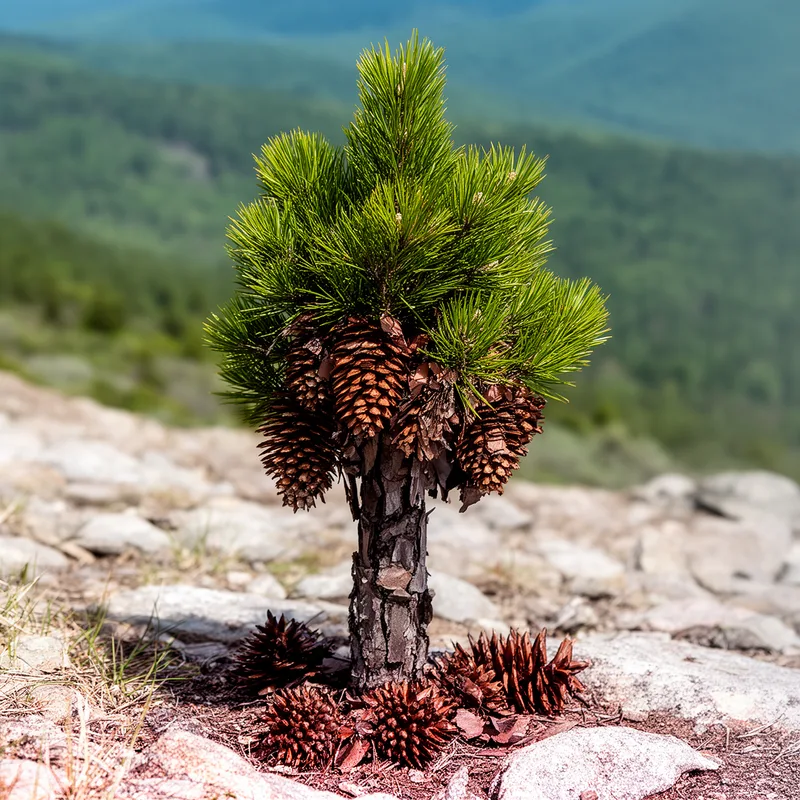
table-mountain pine
- noun
- /ˈteɪbəlˈmaʊntən paɪn/
- Specialized
- The table-mountain pine thrives in rocky soils.
Examples
-
Because of its unique cones, the table-mountain pine can be easily distinguished from other native pines.
-
The table-mountain pine thrives in the dry, rocky soils of the Appalachian mountains.
-
We identified several table-mountain pines during our hike through the nature reserve.
-
Many table-mountain pines grow in the Appalachian Mountains.
-
In the forest, the table-mountain pine stands out with its dark brown flaking bark.
-
The table-mountain pine is known for its unique cones that have thorn-tipped scales.
-
Hiking in the Appalachians, we spotted a rare table-mountain pine among the other trees.
Synonyms

A small Appalachian pine with two thin needles per bundle and cones with pointed thorn-like scales

A small pine tree with two needles together, peeling brown bark, and cones with sharp points
A small pine tree with two long needles, dark peeling bark, and cones with sharp tips
Surface Forms
Morphology
table-mountain + pine
The compound is a straightforward noun phrase built from a place descriptor + tree: 'table-mountain' (a flat-topped mountain or place name) + 'pine' (a type of tree). A B1 learner who knows 'table', 'mountain' and 'pine' can reasonably infer this refers to a kind of pine associated with a table mountain or similar upland habitat, so the meaning is compositionally transparent even if botanical specifics are unknown.
Etymology
Table-mountain pine comes from where the tree grows: dry, rocky high hills that are flat like a table on a mountain, so the words table, mountain, and pine show the picture of the tree. That's why the name means 'a small pine tree' that lives on those high, rocky places.

