

Pinus pinea
- noun
- Specialized
- The characteristic umbrella shape of Pinus pinea makes it easily recognizable in the landscapes of Italy.
Examples
-
The seeds of the Pinus pinea are an important ingredient in Mediterranean cuisine.
-
Ancient Romans cultivated Pinus pinea for both its beauty and its edible nuts.
-
Look at the Pinus pinea!
-
The Pinus pinea tree is often found in coastal regions.
-
Ancient Romans cultivated Pinus pinea for both its beauty and its edible nuts.
-
The seeds of the Pinus pinea are an important ingredient in Mediterranean cuisine.
-
The characteristic umbrella shape of Pinus pinea makes it easily recognizable in the landscapes of Italy.
Synonyms
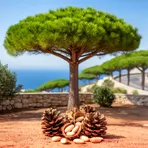
A medium-sized pine tree with a wide top that makes edible pine nuts
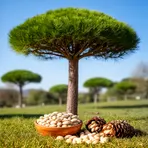
A medium-sized tree with a flat, wide top and edible seeds like almonds

A medium-sized tree from southern Europe with a wide top that makes edible seeds like small almonds
Surface Forms
Morphology
Pinus + pinea
Although 'Pinus' signals the genus of pines, 'pinea' is a Latin species epithet—not an English lexical item—so a B1 learner who knows the constituent words would not be able to derive the specific meaning 'medium-sized pine with umbrella-shaped crown and edible seeds.' Scientific Latin binomials are conventionally opaque to non-specialists and require prior taxonomic or common-name knowledge (e.g., 'stone pine' or 'pine nut'), making this expression non-compositional for typical learners.
Etymology
Pinus pinea is a Latin name: Pinus means 'pine' and pinea points to the tree that gives 'pine nuts'. Imagine an umbrella-shaped pine full of tasty seeds — that picture explains why the name refers to the Mediterranean pine known for its edible seeds.

