
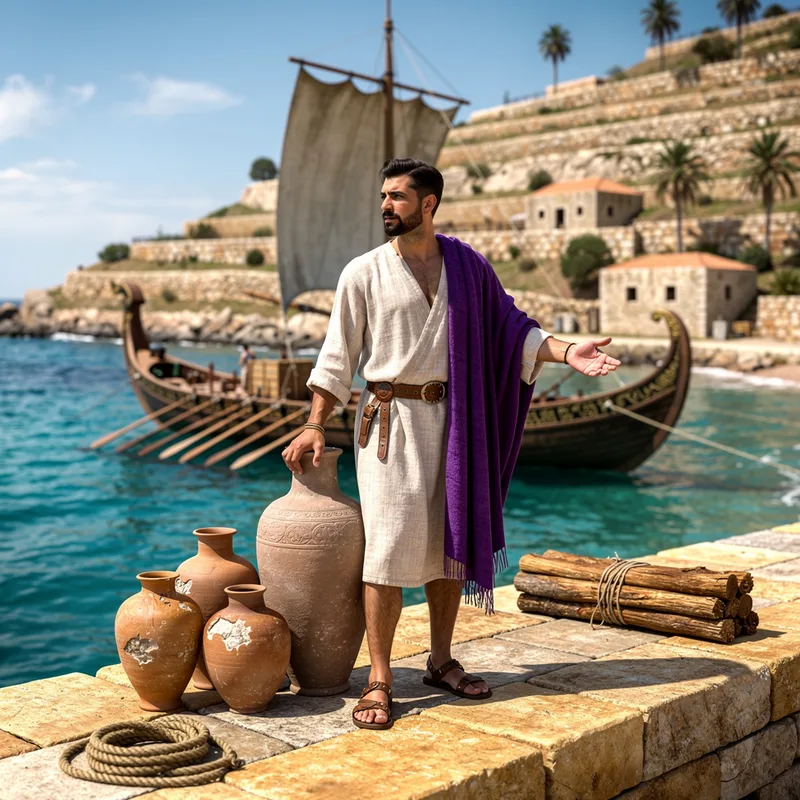
Phoenician


 1
8.7
- proper noun
- /fəˈniːʃən/
- However, I would like to mention a few points: the language of one of the greatest prophets, Prophet Ibrahim, was not Arabic but was Akkadian or Phoenician, the language spoken in Canaan at that time.
- Punic or Phoenician
Examples
-
And I sailed as a Phoenician for a time.
-
This is Phoenician.
-
And before that, Phoenician, Viking, or something.
Fiction book (2000) -
It's clearly Phoenician.
-
This wine is Phoenician.
-
Whether the Motya Youth is Greek or Phoenician/Punic, it is clear that the marble used for it was from the Aegean island of Paros.
Academic text (2014) -
Consequently, the Motya Youth "might be a monument of or for a local resident (a Greek more likely than a Phoenician, but not certainly) who acquired fame, fortune, and aristocratic pretensions driving in the games of Greece."
Academic text (2014) -
The Phoenician traders established routes across the Mediterranean Sea.
-
Historians study the writings of the Phoenician culture to understand their influence on trade.
-
The ancient city of Carthage was founded by Phoenician settlers from present-day Lebanon.
Compounds
- Specialized
1
9.9
An old language once spoken by people of ancient coastal cities in the eastern Mediterranean that is no longer spoken
Surface Forms
Morphology
Etymology
Phoenician comes from Greek phoinix meaning 'purple', because the people from the area of modern Lebanon were known for their purple dye and for long sea journeys. So Phoenician names a person from that ancient seafaring culture.