
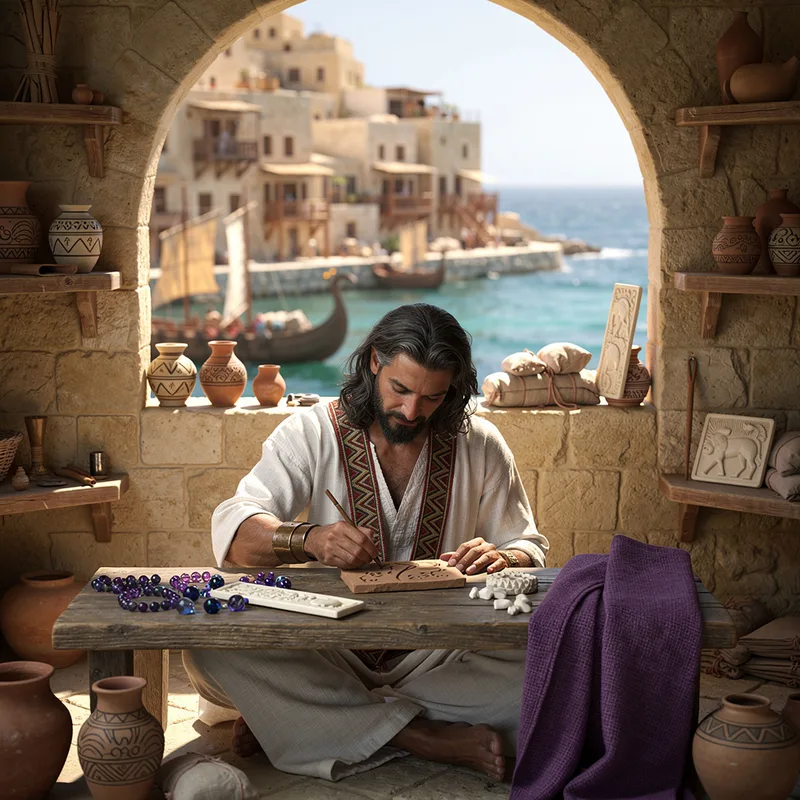
Phoenician
 4
8.3

- adjective
- /fəˈniːʃən/
- Inspired by neo-Punic, an African form of the Phoenician alphabet, Tifinagh is related to scripts that were employed for writing ancient Berber languages.
- Phoenician alphabet
- Phoenician and Greek
- Phoenician god
Examples
-
The sovereignty of Phoenician western Sicily could not go unchallenged.
Academic text (2014) -
The Phoenician civilization was known for its remarkable trade networks across the Mediterranean.
-
It's a page from the log of a Phoenician ship.
-
Below that, he also found Phoenician artifacts.
Academic text (2010) -
Nevertheless, Phoenician soft power was still strong in Spain.
-
Everyone needs to know how to write an alphabet, though it took a Phoenician genius to think it up and make his fortune.
Academic text (1992) -
"The introduction of bellows is one of the most important contributions of Phoenician technology," he says.
Academic text (2010) -
Even after the foreigners' arrival, the mining operations remained in local hands, though the amount of Phoenician influence remains a point of contention.
Academic text (2010) -
The wily Greeks took over the Phoenician alphabet, dispensing with extra consonants that somehow were born again as vowels.
Academic text (2007) -
Like Iraq and its Mesopotamian past, and Lebanon with its Phoenician past, the achievements of Egyptian ancestors were inspiration and legitimization for the emerging greatness of the present.
Academic text (2011)
Compounds
- Specialized

 1
9.9
An old language once spoken by people of ancient coastal cities in the eastern Mediterranean that is no longer spoken
Surface Forms
Morphology
Etymology
Phoenician comes from an old Greek word phoinix meaning 'purple', because the people were famous for a special purple dye they made. So Phoenician is used for things that relate to that ancient people, their culture, or their history.