
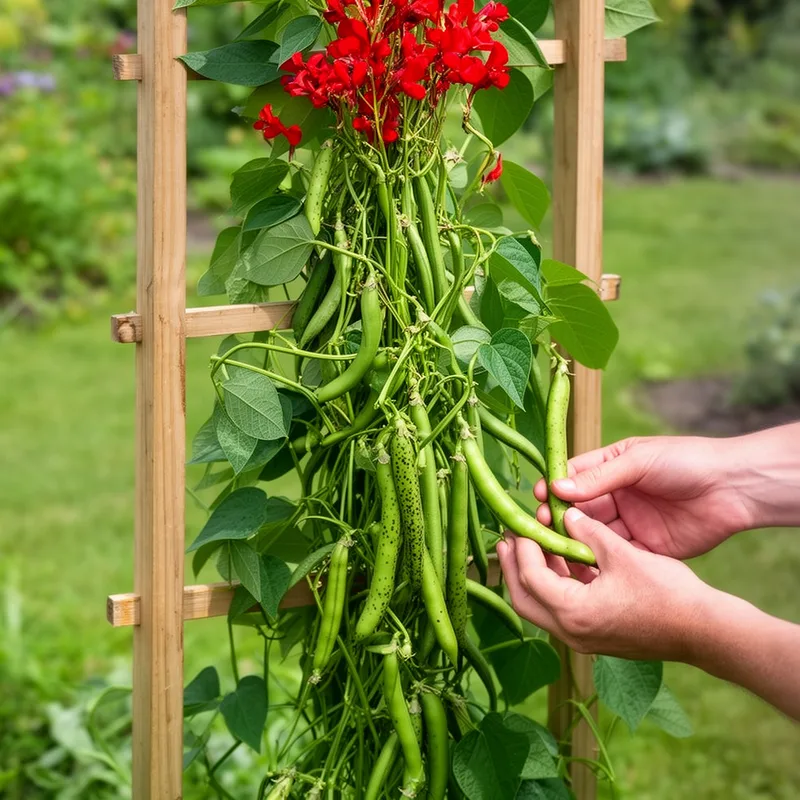
Phaseolus coccineus
- noun
- /ˈfeɪziələs kɒkˈsɪniəs/
- Specialized
- Botanists often refer to the runner bean as Phaseolus coccineus when discussing plant classifications.
Examples
-
The bright red flowers of the Phaseolus coccineus are a striking sight in British gardens.
-
In Great Britain, Phaseolus coccineus is a popular vegetable for both its beans and pods.
-
The Phaseolus coccineus plant thrives in warm climates.
-
In Britain, Phaseolus coccineus is often grown in gardens.
-
In Great Britain, Phaseolus coccineus is a popular vegetable for both its beans and pods.
-
The bright red flowers of the Phaseolus coccineus are a striking sight in British gardens.
-
Botanists often refer to the runner bean as Phaseolus coccineus when discussing plant classifications.
Synonyms


 1
3.7
1
3.7
A climbing plant with long green pods and red flowers grown for food
A climbing bean plant from tropical America that lives for several years and has red flowers and edible pods
A climbing bean plant with red flowers and long edible pods
A climbing plant with red flowers and long edible pods
Surface Forms
Morphology
Phaseolus + coccineus
This is a Latin binomial combining the genus name 'Phaseolus' (a bean) with the adjectival epithet 'coccineus' (literally 'scarlet'/'red'); if a learner knew both constituents they could compositionally infer it refers to a red/scarlet runner bean. However, the epithet is technical/Latin and not attested in common dictionaries, so the form is unlikely to be immediately understandable to a B1 learner without prior exposure.
Etymology
Phaseolus coccineus comes from old Latin words: Phaseolus means 'bean' and coccineus means 'scarlet' or bright red. The name gives a clear picture of a red-flowered bean, so it refers to the runner bean people grow for food.