

Phaseolus aconitifolius
- noun
- Specialized
- The pods of Phaseolus aconitifolius are commonly harvested for both human consumption and animal feed.
Examples
-
Research shows that Phaseolus aconitifolius can improve soil fertility when used as a cover crop.
-
Farmers often cultivate Phaseolus aconitifolius for its nutritious beans.
-
Farmers in arid regions often cultivate Phaseolus aconitifolius because of its drought resistance.
-
The Phaseolus aconitifolius is commonly grown in India.
-
Farmers in arid regions often cultivate Phaseolus aconitifolius because of its drought resistance.
-
Research shows that Phaseolus aconitifolius can improve soil fertility when used as a cover crop.
-
The pods of Phaseolus aconitifolius are commonly harvested for both human consumption and animal feed.
Synonyms
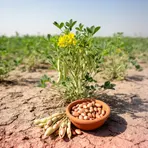
A small plant that makes edible seeds and grows well in hot, dry places

A bean plant from India that grows in dry places and gives edible seeds and improves soil
Surface Forms
Morphology
Phaseolus + aconitifolius
This is a Linnaean binomial: 'Phaseolus' names the genus (beans), so a learner who knows that term can infer this refers to a kind of bean/legume. However, 'aconitifolius' is a Latin species epithet (not a standard English word and not listed in the dictionary) and does not transparently convey the specific identity 'moth bean' or the plant's features to a B1 learner, so the composition is only partially informative.
Etymology
Phaseolus aconitifolius comes from old Latin words: Phaseolus means 'bean' and aconitifolius means 'leaves like aconite', a different plant. So the name is simply 'the bean with aconite-like leaves', and that image helps you remember it is a small, hardy bean grown for food and to improve the soil.

