

Oncorhynchus nerka
- noun
- /ˌɒŋkəˈrɪŋkəs ˈnɜːrkə/
- Specialized
- The Oncorhynchus nerka, commonly known as sockeye salmon, is sought after for its rich flavor and nutritional value.
Examples
-
During their migration, the Oncorhynchus nerka navigate upstream to spawn in the tributaries of northern Pacific rivers.
-
Sockeye salmon (Oncorhynchus nerka) typically require a lake in a system to establish populations, because they usually spawn in streams above the lake or in the margins of the lake.
Academic text (2007) -
Chefs often prefer using Oncorhynchus nerka in their dishes due to the distinctive red flesh and delicious taste.
Synonyms

 2
7.5
2
7.5

A Pacific salmon with red flesh that swims upstream to spawn and then dies


 1
3.4
1
3.4
A salmon from north Pacific rivers with red flesh whose adults die after spawning

A small salmon from the northern Pacific with bright red flesh that dies after spawning

A small Pacific salmon with red flesh whose adults die after spawning
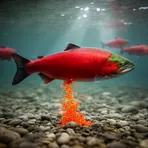
A Pacific salmon with red flesh that returns to rivers in North America and Asia to lay eggs
Surface Forms
Morphology
This is a Linnaean binomial: 'Oncorhynchus' identifies the salmon genus and 'nerka' pinpoints a particular species, so a learner who knows those constituent meanings could infer it refers to a specific type of salmon. However, specific details like the common name 'sockeye', the distinctive red flesh, and life-history note (adults die after spawning) are not directly predictable from the names alone, making the transparency partial rather than full.
Etymology
Oncorhynchus nerka comes from old Greek and a Russian name: Oncorhynchus may mean 'hooked snout' because male fish grow a hooked jaw when they return to rivers to lay eggs, and nerka is the Russian name people used for this red salmon. So the name points to the fish's hooked mouth and its life as a red salmon that returns to rivers to lay eggs and then dies.