
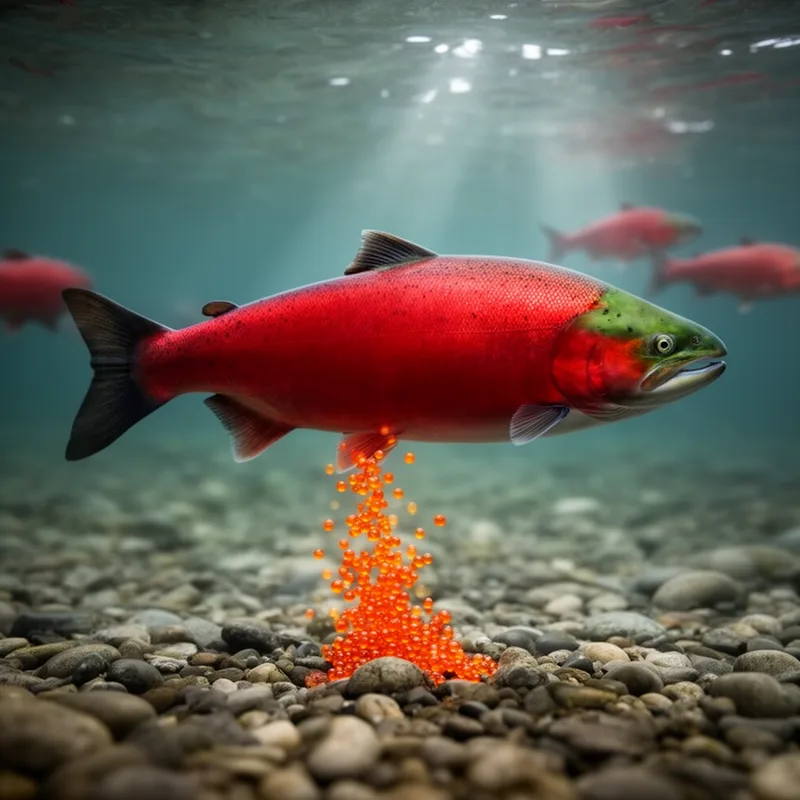
nerka
- noun
- /ˈnɜr.kə/
- US
- Two additional species of salmon, coho salmon (Oncorhynchus kisutch) and kokanee (Oncorhynchus nerka), were introduced in 1933 and 1950.
- Oncorhynchus nerka
Examples
-
The term "Pacific salmon" has traditionally referred to species of the genus Oncorhynchus, five of which (O. gorbuscha, O. keta, O. kisutch, O. nerka, and O. tshawytscha) occur in North America.
Academic text (1991) -
Sockeye salmon (Oncorhynchus nerka) typically require a lake in a system to establish populations, because they usually spawn in streams above the lake or in the margins of the lake.
Academic text (2007) -
The nerka, also known as sockeye salmon, is prized for its rich flavor and firm texture.
-
During the spawning season, the nerka migrates from the ocean back to freshwater rivers.
-
Many fishermen travel to the Pacific Northwest to catch nerka due to its popularity and culinary value.
Synonyms

 2
7.5
2
7.5

A Pacific salmon with red flesh that swims upstream to spawn and then dies


 1
3.4
1
3.4
A salmon from north Pacific rivers with red flesh whose adults die after spawning

A small salmon with red flesh from northern Pacific rivers, often eaten and dying after laying eggs
Compounds
- Specialized
A small salmon with red flesh from northern Pacific rivers, often eaten and dying after laying eggs
Surface Forms
Etymology
Nerka comes from the Russian name for the fish, used for the 'sockeye salmon' of the North and probably borrowed from local native words. So, nerka today simply means that Pacific salmon that turns red and returns to rivers each year.