

blueback salmon
- noun
- /ˈbluˌbæk ˈsælmən/
- Specialized
- After spawning in freshwater streams, every adult blueback salmon dies as part of its natural lifecycle.
Examples
-
The bright red flesh of the blueback salmon is prized by chefs around the world.
-
Fishermen in Alaska rely on the annual blueback salmon run to support their livelihoods.
-
The blueback salmon is a popular fish among anglers.
-
Many restaurants serve blueback salmon in various dishes.
-
The bright red flesh of the blueback salmon is prized by chefs around the world.
-
Fishermen in Alaska rely on the annual blueback salmon run to support their livelihoods.
-
After spawning in freshwater streams, every adult blueback salmon dies as part of its natural lifecycle.
Synonyms

 2
7.5
2
7.5

A Pacific salmon with red flesh that swims upstream to spawn and then dies


 1
3.4
1
3.4
A salmon from north Pacific rivers with red flesh whose adults die after spawning
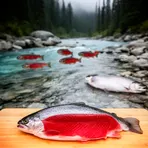
A small salmon with red flesh from northern Pacific rivers, often eaten and dying after laying eggs

A small Pacific salmon with red flesh whose adults die after spawning
Surface Forms
Morphology
The meaning is directly derivable as a type of salmon characterized by a blue back — a straightforward noun+noun composition of 'blueback' + 'salmon'. This is a transparent, non-idiomatic compound: a B1 learner who knows the constituents can infer the referent (a salmon with a blue back), even if they would not deduce specialised biological details like spawning behaviour.
Etymology
The name blueback salmon comes from how the fish looks: at sea it has a shiny blueback, and when it returns to rivers to lay eggs its flesh turns bright red. Because the adults 'die' after laying eggs and the red meat is valued as food, fishermen also call this fish the 'sockeye', which helps explain its life cycle and why people eat it.