
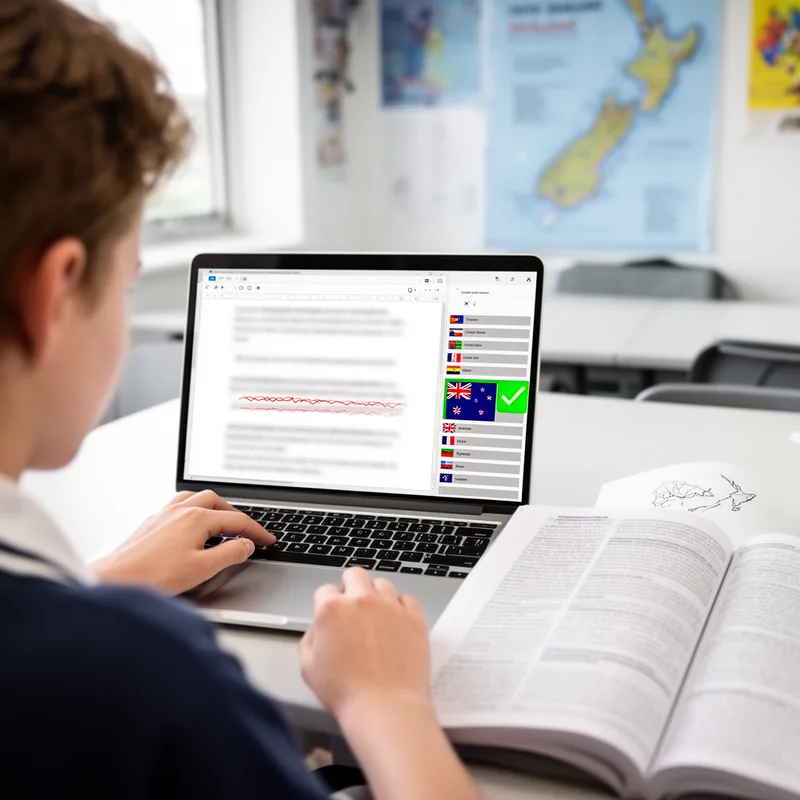
New Zealand English spelling
- noun
- New Zealand
- The New Zealand English spelling of 'colour' includes a 'u'.
Examples
-
You can set your word processor to check for New Zealand English spelling automatically.
-
Writers often consult style guides to ensure consistency in New Zealand English spelling.
-
Many school textbooks in New Zealand use New Zealand English spelling rather than American variants.
-
Many words in New Zealand English spelling differ from American English.
-
Many school textbooks in New Zealand use New Zealand English spelling rather than American variants.
-
Writers often consult style guides to ensure consistency in New Zealand English spelling.
-
You can set your word processor to check for New Zealand English spelling automatically.
Synonyms

Standard English spelling that people use in New Zealand, like organise rather than organize

The rules for spelling, capital letters, hyphens, and punctuation in New Zealand English
Surface Forms
Morphology
new + Zealand + English + spelling
The noun phrase is fully compositional: 'New Zealand' (a place) + 'English' (the language) + 'spelling' (orthographic conventions), so the overall meaning — the way English is spelled in New Zealand — follows directly from the constituents. Proper-name status of 'Zealand' does not block inference, and similar language‑variety + feature constructions exist cross‑linguistically, so a B1 learner who knows the parts will understand it.
Etymology
New Zealand English spelling comes from the way people in New Zealand learned and used English: schools and writers mostly followed British spellings but also changed some word endings and added local words to match how people spoke. So, it now means the standard 'ways of spelling' used across New Zealand.

