

Nestorian


 1
9.9
1
9.9
- adjective
- /nɛˈstɔːriən/
- Specialized
- This form of the heresy, known as monoenergism, resulted from fear of the Nestorian implications of positing two centers of action.
- Nestorian church
Examples
-
Many scholars from the Nestorian tradition contributed to the preservation of ancient texts during the Middle Ages.
-
For centuries, Hira was an important center of the Church of the East, sometimes known as the Nestorian Church, whose modern offshoot is the Assyrian Church of the East.
Blog text (27) -
Hmm, I read Arabic, and I've heard the rumors that Muhammad spent his first forty years as a Nestorian monk!
Blog text (18) -
When he argues that the Son rules one kingdom in his capacity as creator God, and then the other in his capacity as incarnate Redeemer, he risks falling into a Nestorian bifurcation of the person of the Word, denying the continuity between these two works.
Blog text (8) -
Chalcedon's formulation was necessary to combat Eutychianism, while Cyril's language was important to repudiate the Mopsuestian-Nestorian tendency.
Academic text (1991) -
If all the evangelists plying their trade along the back roads of China packed up and left at once, she surmised, their long years of labor would prove as negligible as the "old Nestorian church, a windblown, obliterated tablet upon a desert land."
Academic text (2003) -
The Nestorian Church played a significant role in the spread of Christianity throughout Asia.
-
Nestorian beliefs about the nature of Christ were central to the theological debates of the early Christian Church.
Compounds

- Specialized
A Christian teaching that says Jesus has two separate natures, human and divine
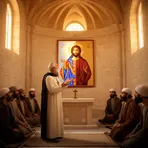
A Christian church in the Middle East that taught Jesus had two separate natures

A Christian group from the 400s in Persia that taught Jesus had two separate natures
Surface Forms
Morphology
Etymology
Nestorian comes from the name Nestorius plus the ending -ian, which means 'related to', like in Newtonian. So 'Nestorian' describes people or things connected to Nestorius or his teaching that Jesus' human and divine natures are 'separate'.