
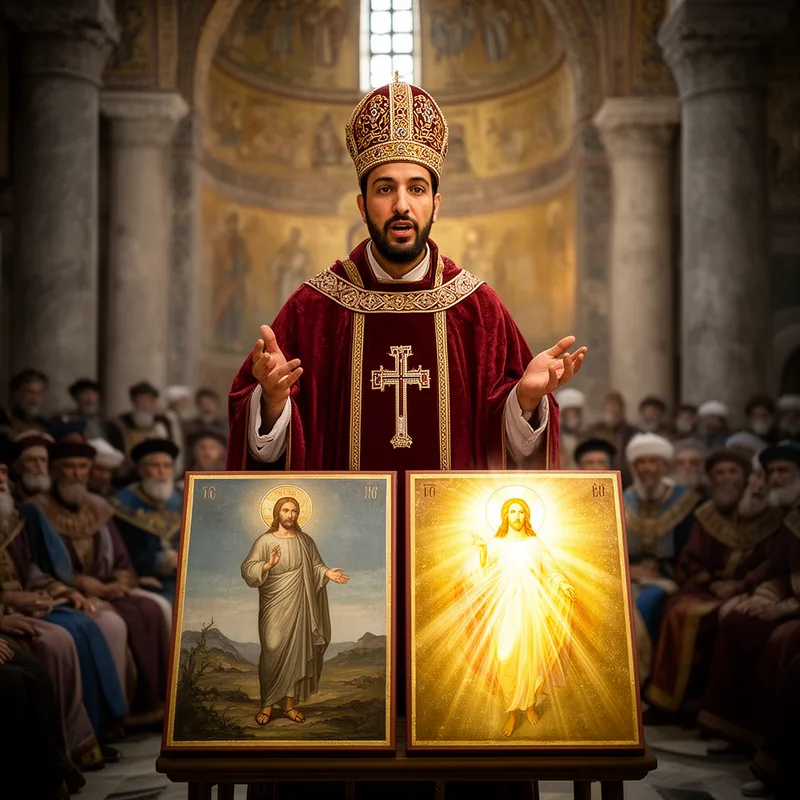
Nestorius


 1
9.9
1
9.9
- proper noun
- /nɛˈstɔːriəs/
- Arius and Nestorius were also good men whose ideas were eventually discarded by a Church developing its doctrine on who Jesus was.
- Nestorius, a bishop
- condemned Nestorius
Examples
-
Consider how poor a story you make of Bethlehem if you believe, with Nestorius, that there were two Persons in the Incarnation: the second Person of the Blessed Trinity and the person of a man, Jesus Christ.
Blog text (8) -
However, one may evaluate the ability or the inability of Nestorius' adversaries to represent accurately his views, I would argue that even in the mature expression of his theology, Nestorius was unable to present an adequate Christological vision that would avoid the impression that the Word of God had taken on or had indwelt a human being with his own human center of existence.
Academic text (1991) -
Nestorius' "prosopic union" failed to easily answer the question of who, rather than what, was the subject of the experiences of Jesus of Nazareth.
Academic text (1991) -
Consequently, we cannot bypass entirely the controversy between St. Cyril and Nestorius of Constantinople.
Academic text (1991) -
On the way to the council, they stop in Constantinople where Victor reunites with his father and receives a promise of imperial support for his monasteries as well as imperial opposition to heretics such as Nestorius.
Academic text (2004) -
As is well known, during the twentieth century there has been a revival of historical interest in Nestorius, and there have been various attempts by scholars to rehabilitate the onetime archfoe of orthodox Christology.
Academic text (1991) -
However, one may evaluate the ability or the inability of Nestorius' adversaries to represent accurately his views, I would argue that even in the mature expression of his theology, Nestorius was unable to present an adequate Christological vision that would avoid the impression that the Word of God had taken on or had indwelt a human being with his own human center of existence.
Academic text (1991) -
Something largely ignored by historians is that Leo himself accepted this (despite the fact that he and Cyril used different theological language) and that he urged the acceptance of either his own Tome or Cyril's (second) letter to Nestorius accepted by the Council of Ephesus.
Academic text (1991) -
We now call them Nestorians, after Nestorius, a bishop in the fifth century.
-
Although they did not even enter into communion with Nestorius, the rebellion became an open one.
Surface Forms
Etymology
Nestorius comes from the Greek name Nestor, a name from ancient stories for a wise old king and linked to a word meaning 'return' or 'homecoming'. So Nestorius is simply a Greek-style personal name, and it belongs to the Syrian bishop whose teachings led to the movement called Nestorianism.