
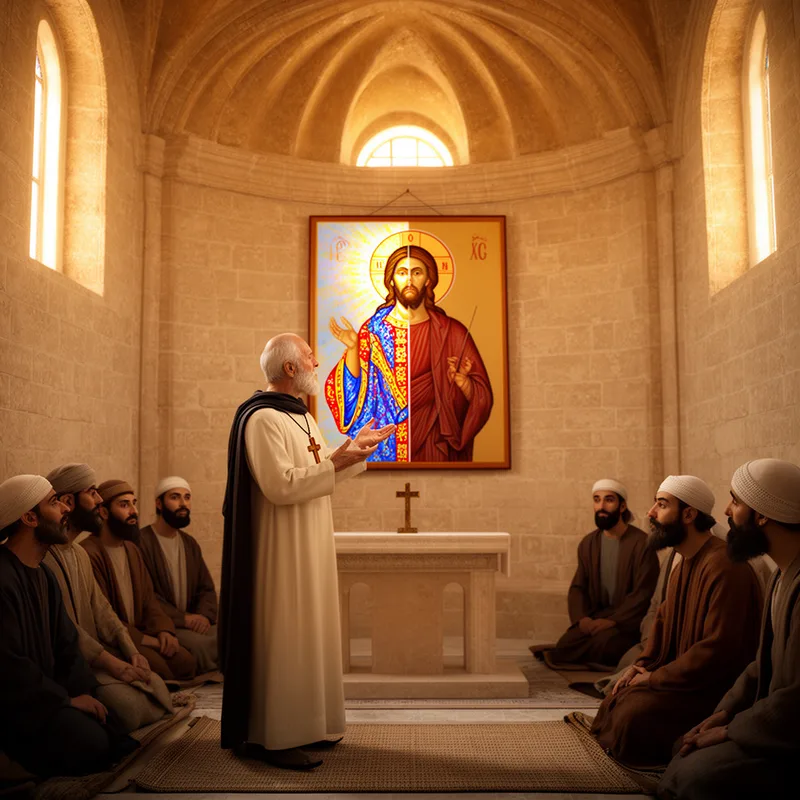
Nestorian Church
- proper noun
- The Nestorian Church played a significant role in spreading Christianity along the Silk Road.
Examples
-
Today, only a small community associated with the Nestorian Church remains in Iraq.
-
Scholars have studied the theological debates that shaped the Nestorian Church in the early centuries.
-
The Nestorian Church played a significant role in the spread of Christianity in Asia.
-
Many scholars study the Nestorian Church to understand early Christian history.
-
The Nestorian Church was influential in the establishment of early Christian communities in the Middle East.
-
In the 13th century, the Nestorian Church had a network of churches and schools across Asia.
-
Historically, the Nestorian Church was known for its distinct teachings about the nature of Christ.
Synonyms

 962
1.0
962
1.0

A group of Christians with the same beliefs and way of worship
 4
2.7
4
2.7
A group of Christians with its own beliefs and ways of worship
Surface Forms
Morphology
This is a straightforward adjective + noun composition: 'Nestorian' names allegiance to Nestorius/Nestorianism and 'church' denotes a Christian body, so a learner who knows both constituents can infer it means the church/denomination associated with Nestorian beliefs. While historical and doctrinal details (5th-century origins, theological nuances) require extra knowledge, the basic denotation as a particular Christian sect is transparently derived from the parts.
Etymology
Nestorian Church is named after a 5th-century bishop called Nestorius, who taught that Jesus had 'two natures' — one human and one divine. So the phrase came to mean the Christian group that followed his teaching and spread across the Middle East.