

Neandertal man
- noun
- /niˈændərˌtæl mæn/
- UK
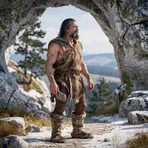
- Fossils of Neandertal man provide valuable insights into human evolution and the lifestyles of our ancient ancestors.
Examples
-
Researchers have uncovered tools used by Neandertal man, revealing their advanced skills in survival and hunting.
-
Studies suggest Neandertal man lived in Europe during the Middle Paleolithic period, showcasing robust features.
-
Why did it prove to be beyond the capacity of Archaic or Neandertal man?
Fiction book (1994) -
Neandertal man perhaps had it to a degree, but he had diverged before the full effect of the water phase was felt, so he was more limited in this seemingly incidental respect.
Fiction book (1994) -
"I predict just as Homo sapiens from Africa replaced Neandertal man in Europe after the last ice age, Homo superiorensis from Africa will do the same to etc. after the next ice age."
Blog text (28) -
Because if this supposition is correct, the delay in the advance of modern mankind across Eurasia was not because of the resistance of Archaic man or Neandertal man, but because the giant Sahara Desert of Africa prevented the new thinking from reaching the fringe.
Fiction book (1994)
Synonyms
 1
7.4
1
7.4

An early human who lived long ago in Europe and western Asia
 1
7.5
1
7.5
A kind of early human that lived in Europe and western Asia long ago

An extinct group of humans that lived in Europe and western Asia long ago

An extinct type of human that lived in Europe and western Asia long ago
Surface Forms
Morphology
The phrase combines a species name 'Neandertal' (an archaic human species) with 'man' (an individual human), so the meaning 'a human of the Neandertal species' is directly compositional. This species-name + noun pattern is cross-linguistically transparent and would be understandable to a B1 learner who knows both constituent words.
Etymology
Neandertal man comes from the Neander Valley in Germany, where bones of this extinct human were first found in the 1800s. So Neandertal, meaning the valley, and man together refer to that old human type, and today the phrase means 'an extinct species of human'.