

Neandertal
- adjective
- /niˈændərˌtɑl/
- UK
- Subtitles translated the postures and gestures Auel imagines formed the basis of Neandertal language.
- Neandertal genome
- Neandertal finds
Examples
-
Neandertal palates were a lot lower than ours, so they didn't have a good echo chamber for projection.
Blog text (11) -
She discounts the idea that modern humans completely replaced Neandertal populations in Europe and believes that the two groups could have interbred.
Academic text (2002) -
Fortuitously, she selected archaeologist Ralph Solecki's Shanidar, The First Flower People, his 1971 account of excavating a Neandertal cave site in Iraq.
Academic text (2002) -
Les Eyzies contains the rock shelter of Cro-Magnon, a name synonymous with the first modern Europeans, and lies near many well-known sites occupied by these people and their Neandertal contemporaries.
Academic text (2002) -
The few remnants we can study may be the Neandertal equivalent of our distant descendants stumbling upon the human remains of some survivors of a nuclear or other holocaust and extrapolating our entire history from those few clues, not realizing that they were dealing with specimens surviving in extremis.
Blog text (12) -
The Neandertal skull shows distinctive features that differ from modern humans.
-
Studies of Neandertal tools indicate they were skilled hunters.
-
Researchers are examining Neandertal art to understand their cultural expressions.
Synonyms

 19
8.6
19
8.6

Relating to the early human species or showing primitive, rude behaviour
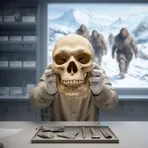
Relating to the ancient human called Neanderthal
Compounds

A type of human that lived in Europe and western Asia long ago and is now extinct
Surface Forms
Etymology
Neandertal as an adjective comes from the same place name, Neander + tal, the German valley where the remains were found, and tal means 'valley', like 'dale'. So calling something Neandertal means it is 'from' or 'like' the people who came from that valley.