

Monocotyledones
- noun
- /ˌmɒnəˌkɒtɪˈliːdoʊniːz/
- Specialized
- Grasses, lilies, and orchids are all part of the Monocotyledones group, characterized by their single cotyledon.
Examples
-
All grasses belong to the Monocotyledones, distinguished by their single seed leaf and parallel leaf veins.
-
The Monocotyledones include important agricultural plants, such as rice and wheat.
-
Orchid flowers are a prime example of the diversity found within the Monocotyledones.
-
Unlike the dicots, Monocotyledones display scattered vascular bundles within their stems.
-
The Monocotyledones family includes many common plants.
-
Many Monocotyledones have long, narrow leaves.
-
Many species within the Monocotyledones have leaves that exhibit parallel venation.
Synonyms

A large group of flowering plants with one seed leaf and leaves with parallel veins, like grasses and orchids
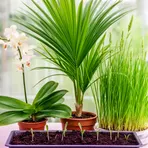
Flowering plants that have one seed leaf and usually parallel veins, like grasses and palms
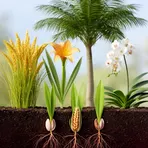
Flowering plants whose seeds have one seed leaf, like grasses, lilies, orchids, and palms
Surface Forms
Morphology
Monocotyledones = monocotyledon (semi-transparent) = mono + cotyledon + es
The word is just the botanical base 'monocotyledon' with a regular plural ending, so the immediate change is straightforward.
Etymology
Monocotyledones comes from mono- 'one' and cotyledon 'seed leaf', so the name means a plant with 'one seed leaf'. These are the flowering plants like grasses, lilies, palms, and orchids, which is why we often call them 'monocots'.

