

Monocotyledonae
- noun
- /ˌmɒnəˌkɒtɪˈliːdəniː/
- Specialized
- Unlike dicotyledons, members of the Monocotyledonae typically have parallel leaf veins.
Examples
-
Palm trees are classic examples of plants classified under the Monocotyledonae.
-
Many staple crops, such as rice and wheat, belong to the Monocotyledonae.
-
The Monocotyledonae family includes many important agricultural crops.
-
Did you know that Monocotyledonae are characterized by their parallel leaf veins?
-
Many common plants, such as grasses and lilies, belong to the class of flowering plants known as Monocotyledonae.
-
Scientists study Monocotyledonae to understand their unique features, such as having only one cotyledon in their seeds.
-
The botanical classification includes Monocotyledonae for plants with a single embryonic leaf, distinguishing them from other groups.
Synonyms

A large group of flowering plants with one seed leaf and leaves with parallel veins, like grasses and orchids
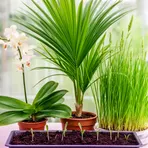
Flowering plants that have one seed leaf and usually parallel veins, like grasses and palms

A group of flowering plants with seeds that have one seed leaf, like grasses and orchids
Surface Forms
Morphology
Monocotyledonae = monocotyledon (semi-transparent) = mono + cotyledon + ae
The target is formed by adding the Latin plural ending -ae to the base 'monocotyledon', so the final step is straightforward.
Etymology
Monocotyledonae is made of mono- ('one') and cotyledon ('seed leaf'). So it names plants whose seeds have a single first leaf, like grasses, lilies, orchids and palms.

