
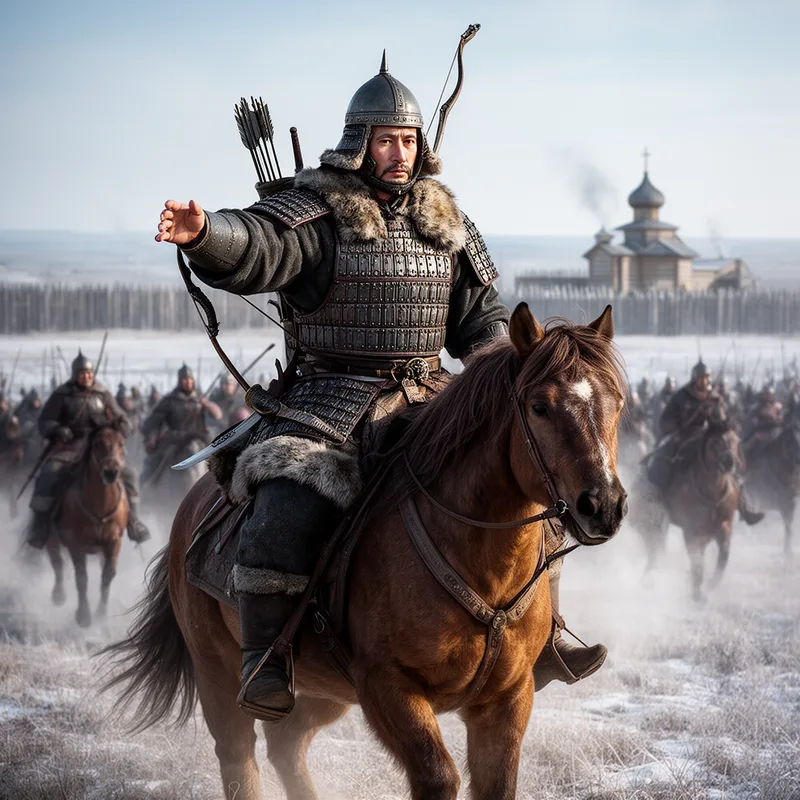
Mongol Tatar
- noun
- The Mongol Tatar forces swept across the Russian plains in the 13th century, altering the course of history.
Examples
-
The Mongol Tatar invasions changed the course of Russian history.
-
Historians debate the influence that Mongol Tatar rulers had on medieval Russian society.
-
Artifacts from the Mongol Tatar period are displayed in the national museum.
-
Many Mongol Tatars settled in the region during the 13th century.
-
The Mongol Tatar forces swept across the Russian plains in the 13th century, altering the course of history.
-
Historians debate the influence that Mongol Tatar rulers had on medieval Russian society.
-
Artifacts from the Mongol Tatar period are displayed in the national museum.
Synonyms
 7
9.9
7
9.9

A person from a Mongol group in Central Asia who invaded Russia and Eastern Europe in the 13th century
 5
6.0
5
6.0
A member of the Central Asian people who formed a vast empire under Genghis Khan
 2
3.4
2
3.4
A person from Mongolia or whose family comes from Mongolia
Surface Forms
Morphology
The compound simply combines two ethnonyms ('Mongol' + 'Tatar'), so a learner who knows those constituent words can reasonably infer it refers to a person or group associated with those peoples (historically Central Asian peoples/invaders). This is a straightforward, non-idiomatic naming pattern rather than a metaphoric or shifted meaning, making the expression transparent.
Etymology
Mongol Tatar comes from the names Mongol, meaning people from Mongolia, and Tatar, a name Europeans used for the tribes of the wide grassy lands of Central Asia. It was used for the horse-riding groups who came to invade Russia in the 13th century, so today it means 'a member of those Mongolian people, especially the invaders'.