
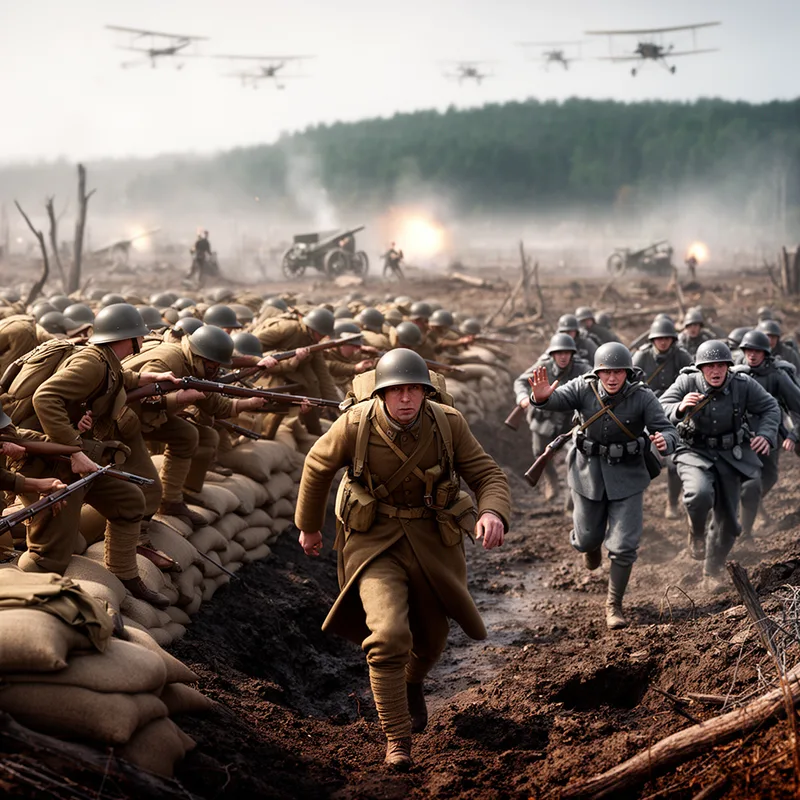
Meuse-Argonne Offensive
- proper noun
- /ˈmjuːz-ɑːrˈɡɒn əˈfɛnsɪv/
- Many historians consider the Meuse-Argonne Offensive a turning point that hastened the end of the war.
Examples
-
The Meuse-Argonne Offensive was a turning point in World War I.
-
The Meuse-Argonne Offensive was one of the largest operations involving American troops during World War I.
-
General Pershing commanded the Allied forces in the Meuse-Argonne Offensive, which ultimately led to the German retreat.
-
Wow! The Meuse-Argonne Offensive was a remarkable achievement!
-
More than a million U.S. soldiers fought in the Meuse-Argonne Offensive, the largest and costliest battle in American history.
-
The Meuse-Argonne Offensive was a crucial campaign that helped lead to the end of World War I.
-
During the Meuse-Argonne Offensive, American forces played a pivotal role in pushing back German troops.
Synonyms
A large American attack in World War I that helped push back German soldiers

A major 1918 American attack during World War I that pushed German troops back in northeast France
Surface Forms
Morphology
Meuse-Argonne + offensive
This is compositionally transparent: the phrase combines a place-name (Meuse-Argonne) with 'offensive' (a sustained military attack), so a learner who knows both constituents can infer it refers to a military campaign at Meuse-Argonne. Detailed historical information (dates, scale, national forces) is not derivable from the words, but the basic event-type is directly predictable from the parts.
Etymology
Meuse-Argonne Offensive gets its name from the two places where the fighting happened: the Meuse River and the Argonne Forest, and 'offensive' means a big 'attack'. So the name refers to the major American-led 1918 campaign that pushed German armies back and helped end the war.

