
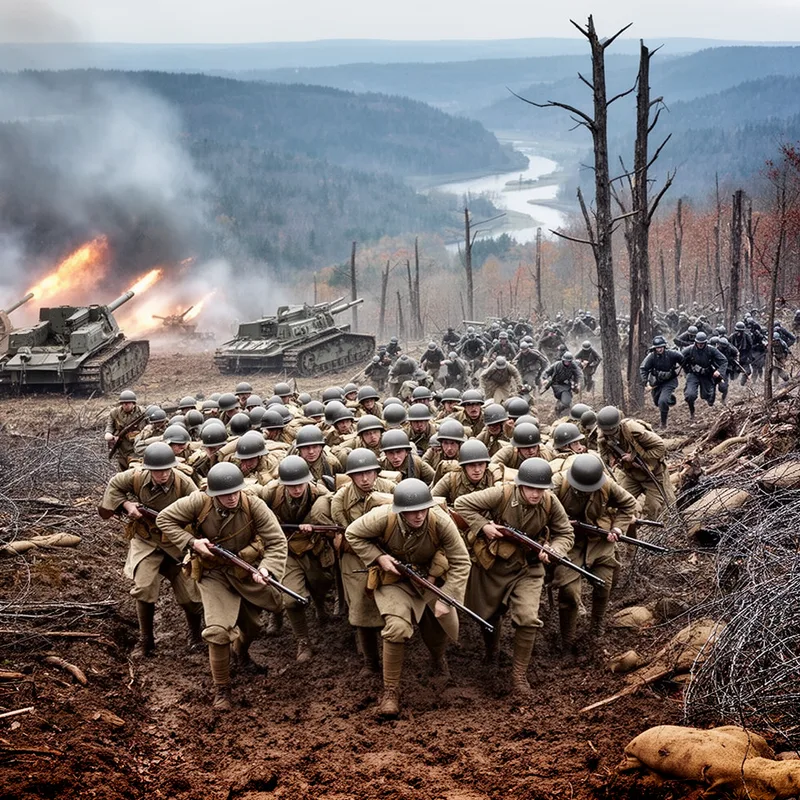
Meuse-Argonne operation
- noun
- /ˈmjuːz-ɑːrˈɡɒn ˌɒpəˈreɪʃən/
- The Meuse-Argonne operation was the largest American military offensive of World War I.
Examples
-
General Pershing led U.S. forces in the Meuse-Argonne operation that helped end the war.
-
Historians often discuss the impact of the Meuse-Argonne operation on the final outcome of World War I.
-
The Meuse-Argonne operation was a turning point in World War I.
-
Many historians regard the Meuse-Argonne operation as crucial.
-
General Pershing led U.S. forces in the Meuse-Argonne operation that helped end the war.
-
Historians often discuss the impact of the Meuse-Argonne operation on the final outcome of World War I.
-
The Meuse-Argonne operation was the largest American military offensive of World War I.
Synonyms

A large 1918 American attack led by General Pershing, the biggest US operation in World War I

A major 1918 American attack during World War I that pushed German troops back in northeast France
Surface Forms
Morphology
Meuse-Argonne + operation
The word 'operation' clearly signals a military campaign and 'Meuse-Argonne' behaves as a place-name, so a learner who knows both constituents can infer this refers to a military operation at Meuse‑Argonne. However, the specific historical details (that it was a major American‑led WWI offensive and its significance) are not derivable from the parts alone, so full understanding requires prior knowledge.
Etymology
The name Meuse-Argonne operation comes from the two places where the fighting happened: the Meuse River and the Argonne Forest. Because American troops led a large attack there in 1918 that helped 'push the enemy back', the name now means that major U.S.-led campaign at the end of World War I.

