
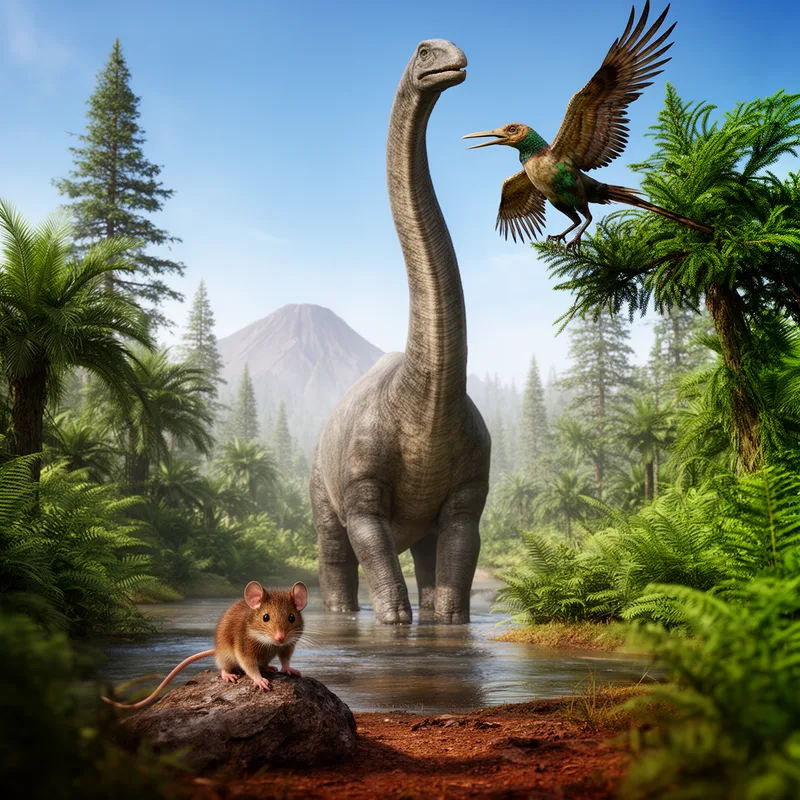
Mesozoic era
 1
7.2
1
7.2

- noun
- /ˌmɛzoʊˈzoʊɪk ˈɛrə/
- Specialized
 :
era mesozoica
:
era mesozoica
- Pterodactyls were flying reptiles that existed during the Mesozoic era.
Examples
-
The laws of physics didn't change at the end of the Mesozoic era.
Fiction book (2002) -
It is better that capitalism has survived the Cold War, just as it was better that the mammals survived the Mesozoic era when dinosaurs became extinct.
Academic text (1993) -
In the Mesozoic era, about 250 million years ago, dinosaurs started to be the dominant land animals.
-
The Mesozoic era is known for the rise and fall of dinosaurs and the development of early mammals.
Synonyms


 1
8.0
1
8.0
A long time 230 to 63 million years ago when reptiles like dinosaurs lived on Earth
A period about 230 to 63 million years ago when dinosaurs were the main animals
Surface Forms
Morphology
The phrase is fully compositional: 'Mesozoic' names a specific geological time (the age of dinosaurs) and 'era' denotes a large geologic timespan, so the combined phrase straightforwardly denotes that particular geological era. This is a descriptive, cross-linguistically common naming pattern, so a B1 learner who knows both constituents will readily understand the meaning.
Etymology
Mesozoic era comes from old Greek words: meso meaning 'middle' and zoic meaning 'life'. It was the 'middle' age of Earth's animal life, the long time when dinosaurs ruled, so the name helps you remember it is the era between older and newer ages.