
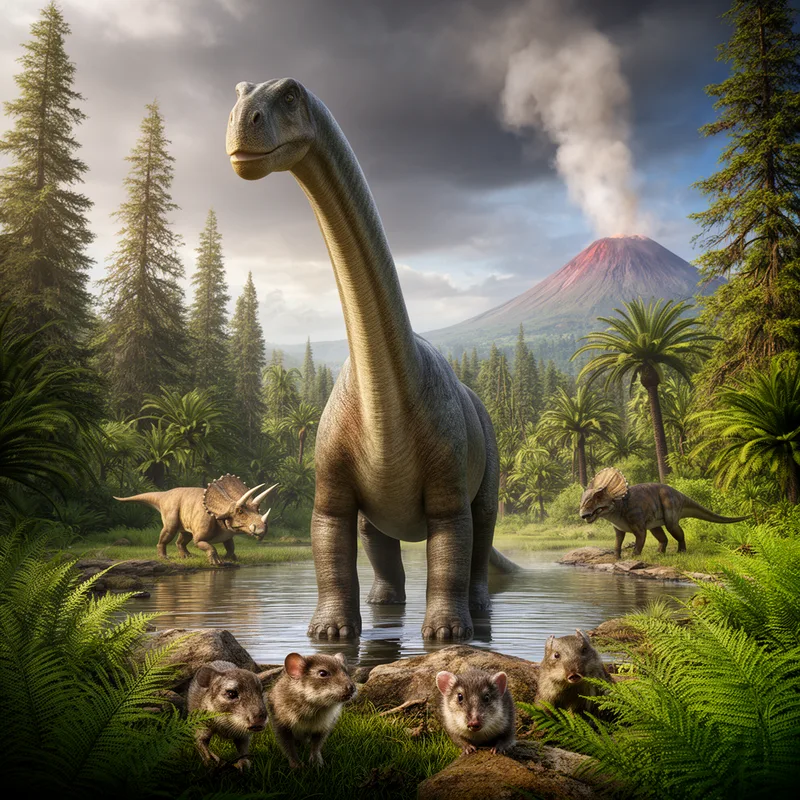
Mesozoic
 1
9.9
1
9.9

- adjective
- /ˌmɛzoʊˈzoʊɪk/
- Specialized
 :
mesozoico
:
mesozoico
- During the Mesozoic era, the Earth's climate was warmer, supporting a diverse range of species.
- Mesozoic era
- Mesozoic period
- Mesozoic mammal
Examples
-
The Late Cretaceous is the very last period of the Mesozoic Era, and it is the age of Mosasaurs.
-
It is better that capitalism has survived the Cold War, just as it was better that the mammals survived the Mesozoic era when dinosaurs became extinct.
Academic text (1993) -
The laws of physics didn't change at the end of the Mesozoic era.
Fiction book (2002) -
And directly below is our Mesozoic jungle river, where, if you are lucky, you just may catch a glimpse of a very rare carnivore.
Fiction book (1990) -
Here we are in London, in one of the most beautiful galleries devoted to Mesozoic marine reptiles.
-
Unprecedented numbers of Mesozoic birds discovered worldwide over the past twenty years have contributed to a revolution in evolutionary thought among paleontologists.
Academic text (1998) -
Although much has been written recently about the behavior and capabilities of these Mesozoic giants, little actual evidence regarding their behavior and physical limitations can be determined from the bones themselves.
Academic text (1991) -
And these animals ruled the seas for 180 million years, throughout all three Mesozoic periods, Triassic, Jurassic and Cretaceous.
-
The geological substrate is characterized by Mesozoic limestone, marl, and residual deposits.
Blog text (27) -
Mesozoic sedimentary rocks are exposed in the eastern half of the quadrangle, where resistant sandstone units form cliffs, escarpments, mesas, and local plateaus.
Blog text (1)
Compounds

- Specialized
1
7.2
A time about 230 to 63 million years ago when dinosaurs lived and early mammals and birds appeared
Surface Forms
Morphology
Etymology
Mesozoic comes from Greek parts meso- meaning 'middle' and -zoic from zoe meaning 'life' or 'animals', the same root as zoo. So used as an adjective, Mesozoic describes things 'from the middle life era', like rocks or fossils that come from the time when dinosaurs were common.