
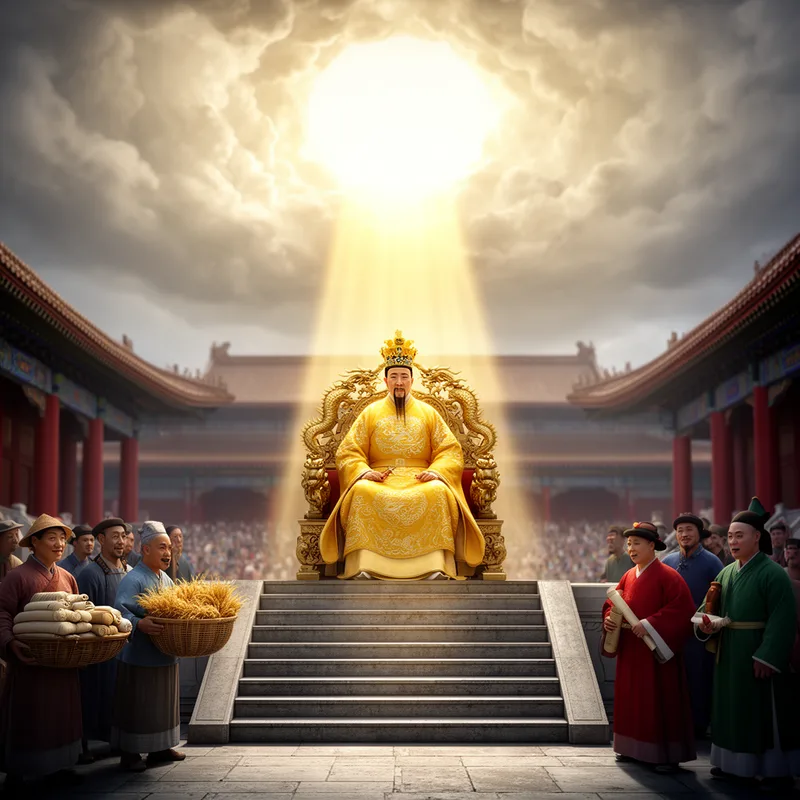
Mandate of Heaven
- noun
- /ˈmænˌdeɪt əv ˈhɛvən/
- Literature
- For Confucius, the ultimate justification for rulership was 'the Mandate of Heaven.' Though seldom formulated clearly, one can speculate that this must also hold for the scholar who is engaged in simpler self-cultivation.
Examples
-
According to Chinese tradition, rulers must govern justly to maintain their Mandate of Heaven.
-
Political legitimacy in Confucian China rested on the Mandate of Heaven, which defines politics in terms of morality.
Academic text (1992) -
They take Confucius's talk of the mandate of Heaven as referring to "the specific environing conditions that set up the viable possibilities in a particular social setting or historical epoch" (12).
Academic text (1998) -
Hall and Ames maintain that the mandate of Heaven is purely contingent and context-relative to discredit the notion of rights and to justify the suppression of the democracy movement at Tiananmen Square.
Academic text (1998) -
The Mandate of Heaven was a vital doctrine that justified the rise and fall of dynasties in ancient China.
-
Many believed that losing the Mandate of Heaven would lead to a ruler's downfall and the end of their dynasty.
Synonyms

 3
8.6
3
8.6

A belief that a king or queen rules because God chose them and people must obey
 1
9.9
1
9.9
A political idea that kings get their power from God and are not controlled by their people
Surface Forms
Morphology
A learner who knows 'mandate' (authority) and 'heaven' (divine realm) can plausibly infer a general sense of 'authority granted by heaven', so the basic idea of divine legitimacy is somewhat recoverable from the parts. However, the full, culturally specific doctrine (that this right is conditional on virtue and can be lost) is not predictable from the constituent words alone, so the expression is only partially transparent to B1 learners.
Etymology
Mandate of Heaven comes from an old Chinese belief that Heaven was a 'higher power' that gave an emperor the 'right to rule' only if he was good. If the emperor became cruel or weak, Heaven would take that 'right' away, so losing the Mandate helped explain why rulers could be removed.