
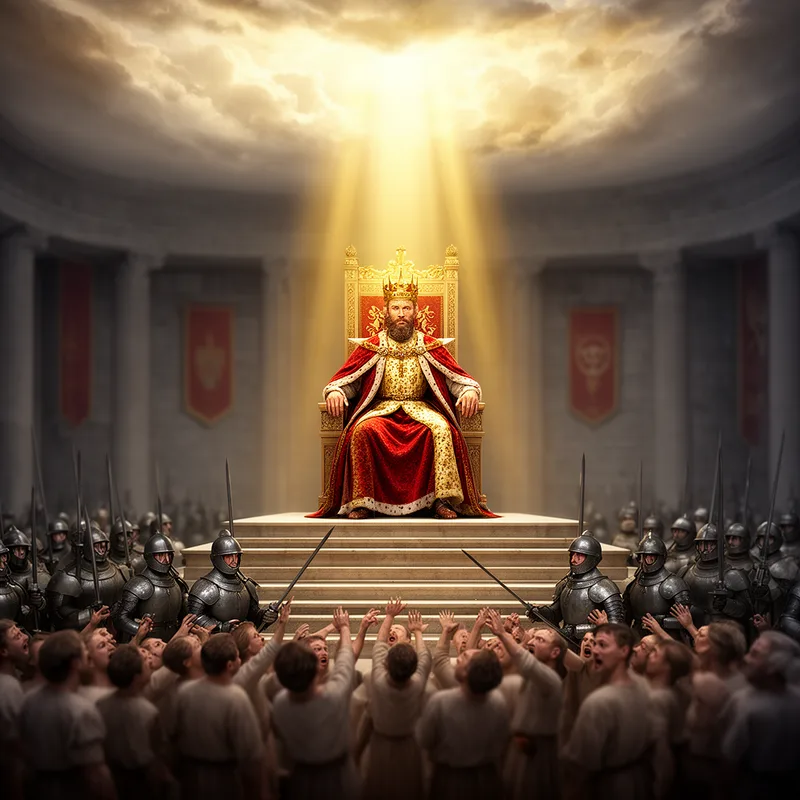
divine right of kings
 1
9.9
1
9.9

- noun
- In the first treatise, Locke refutes the belief in the divine right of kings.
Loading YouTube…
Watch on YouTubeThey're celebrating a horrible thing, divine right of kings, oppression.
- They're celebrating a horrible thing, divine right of kings, oppression.
- All across Europe, east and West, the the divine right of kings was being asserted and it could have gone the other way.
- You can be, you know, you can have like the divine right of kings.
Examples
-
It's the last vestige of the divine right of kings.
-
This concept of the mutual consent of the governed became the basis for the denunciation of the divine right of kings at the dawn of the European Enlightenment.
Academic text (2000) -
The one is the common right of humanity, and the other the divine right of kings.
Academic text (2009) -
All across Europe, east and West, the the divine right of kings was being asserted and it could have gone the other way.
-
A government's legitimacy does not come from majority vote, any more than it comes from the divine right of kings.
Blog text (34) -
The divine right of kings was neither divine nor a right: it was a creation, much like the cognitive elite.
Academic text (1996) -
It is crucial to Locke's account, as you point out, that he starts from a prior assumption about 'God's purpose for man' analogous to the contemporary view which Locke was challenging, 'the divine right of kings.'
Blog text (4) -
Many Enlightenment thinkers argued against the divine right of kings as a justification for absolute authority.
-
The divine right of kings was a widely accepted principle in Europe before the rise of democratic ideas.
-
Critics of the divine right of kings believed that rulers should be accountable to their subjects.
Synonyms
 3
8.6
3
8.6
A belief that a king or queen rules because God chose them and people must obey

A traditional Chinese idea that Heaven gives emperors the right to rule while they govern well
How Legitimate
1
9.9
 24
7.7
24
7.7
- Formal
10
5.4
588
3.4
5
9.3
Surface Forms
Morphology
The phrase is directly compositional: 'divine' (from God) + 'right' (entitlement) + 'of kings' yields the idea that kings have an entitlement granted by God. This political/doctrinal meaning is easily inferable from the constituents and has clear parallels in many other languages, so a B1 learner who knows the words would understand the basic sense.
Etymology
Divine right of kings comes from the old idea that a king's power was a gift from God. Picture God placing a crown on the king and giving him the right to rule. That's why the phrase means 'that kings rule directly from God' and are 'not answerable to their subjects'.