
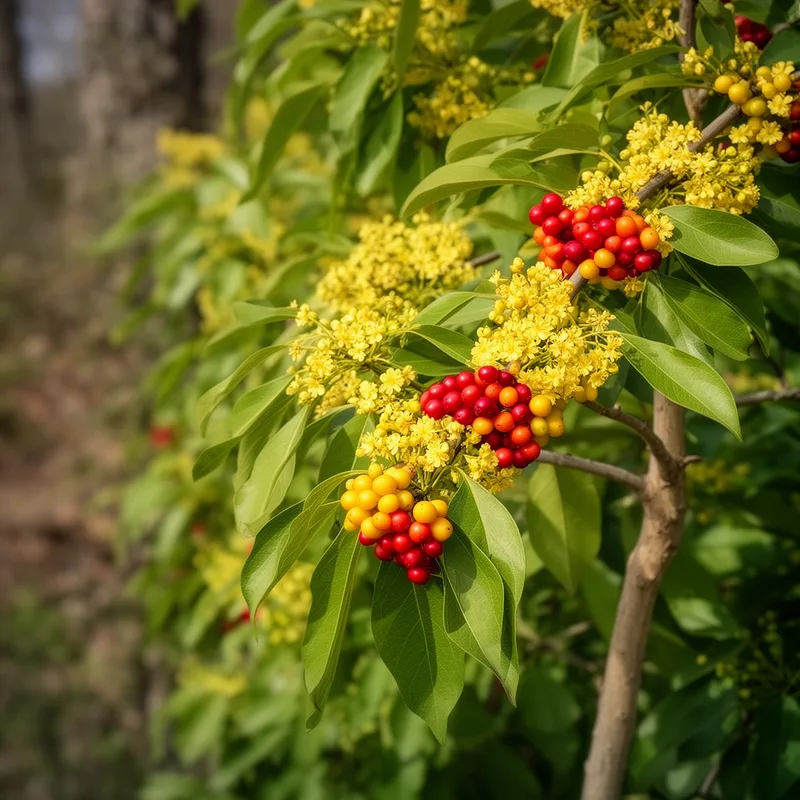
Lindera benzoin
- noun
- /lɪnˈdɛrə bɛnˈzɔɪn/
- Specialized
- Gardeners often plant Lindera benzoin for its fragrant foliage and winter interest.
Examples
-
The bright red berries of Lindera benzoin attract many birds in the fall.
-
Native peoples traditionally used the leaves and stems of Lindera benzoin to make tea.
-
Look at that stunning Lindera benzoin!
-
The Lindera benzoin is often found in moist, wooded areas.
-
Gardeners often plant Lindera benzoin for its fragrant foliage and yellow flowers.
-
The bright red berries of Lindera benzoin attract many birds in the fall.
-
Native peoples traditionally used Lindera benzoin leaves to make herbal tea.
Synonyms

A small bush that loses its leaves each year with strong-smelling leaves, yellow flowers, and red or yellow berries

A small bush from eastern North America with leaves that have a strong smell and red or yellow berries

A small shrub with fragrant leaves, yellow flowers, and red or yellow berries
A bush that loses its leaves in winter with fragrant leaves, yellow flowers, and red or yellow berries

A shrub with fragrant leaves, flowers, and red berries
Surface Forms
Morphology
Both constituents are genus names referring to aromatic plants, so a learner who knows these words can infer that Lindera benzoin is a plant species (likely an aromatic shrub). However, the precise species characteristics (deciduous shrub with specific flowers and berries) and the use of Latin binomial naming are not fully predictable for a B1 learner, so the relation is only partially transparent.
Etymology
Lindera benzoin may come from the person who first studied the plant and from its spicy smell: Lindera likely honors a plant scientist, and benzoin points to a sweet, spicy scent. That's why people call it the 'spicebush' and why its leaves and bark smell so strong.

