
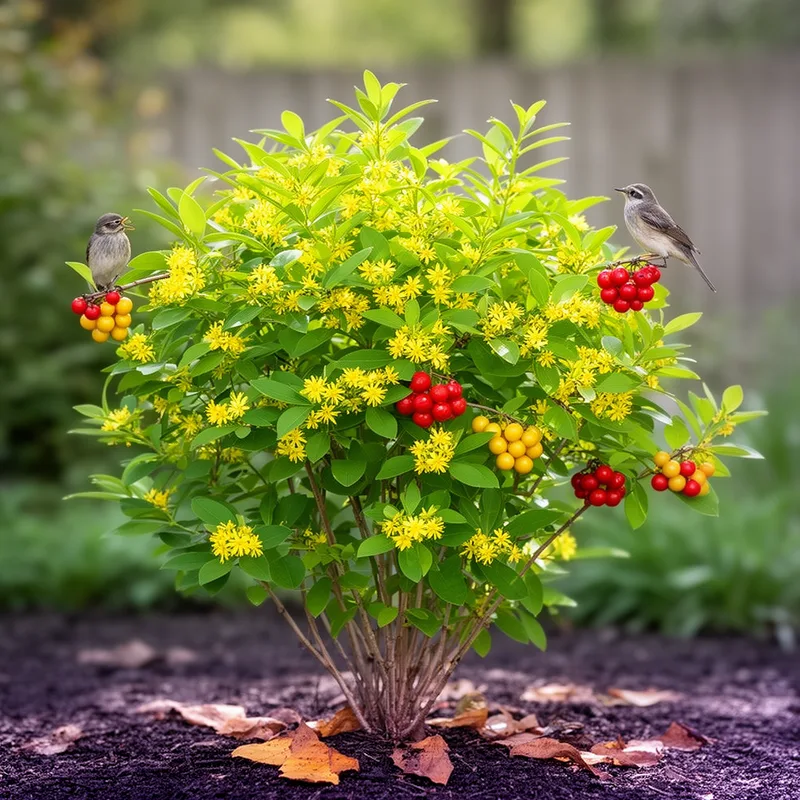
American spicebush
- noun
- /əˈmɛrɪkən spaɪsˌbʌʃ/
- US
- Botanists identify the American spicebush by its aromatic leaves and clusters of small yellow flowers.
Examples
-
The American spicebush is often planted in gardens for its fragrant foliage and attractive berries.
-
Wildlife such as birds are attracted to the berries produced by the American spicebush.
-
The American spicebush blooms in early spring.
-
Many gardeners love the American spicebush for its fragrance.
-
Botanists identify the American spicebush by its aromatic leaves and clusters of small yellow flowers.
-
The American spicebush is often planted in gardens for its fragrant foliage and attractive berries.
-
Wildlife such as birds are attracted to the berries produced by the American spicebush.
Synonyms

A shrub with fragrant leaves and bark, yellow flowers, and red or yellow berries

A small bush from eastern North America with leaves that have a strong smell and red or yellow berries
A bush that loses its leaves in winter with fragrant leaves, yellow flowers, and red or yellow berries

A small shrub with fragrant leaves, yellow flowers, and red or yellow berries

A shrub with fragrant leaves, flowers, and red berries
Surface Forms
Morphology
The noun phrase is a straightforward adjective + noun composition: 'American' specifies origin or variety of the noun 'spicebush', so the meaning 'a spicebush from America' is directly derivable from the constituents. This is a common, cross-linguistic compositional pattern that a B1 learner who knows both words would readily understand.
Etymology
American spicebush may be named for its strong, warm smell: the leaves and bark give a spicy scent, so people thought of it as a spice that grows on a bush. Early settlers even used the leaves as a 'spice' or to make a 'tea', so the name helps you remember that the plant smells and tastes spicy.

