
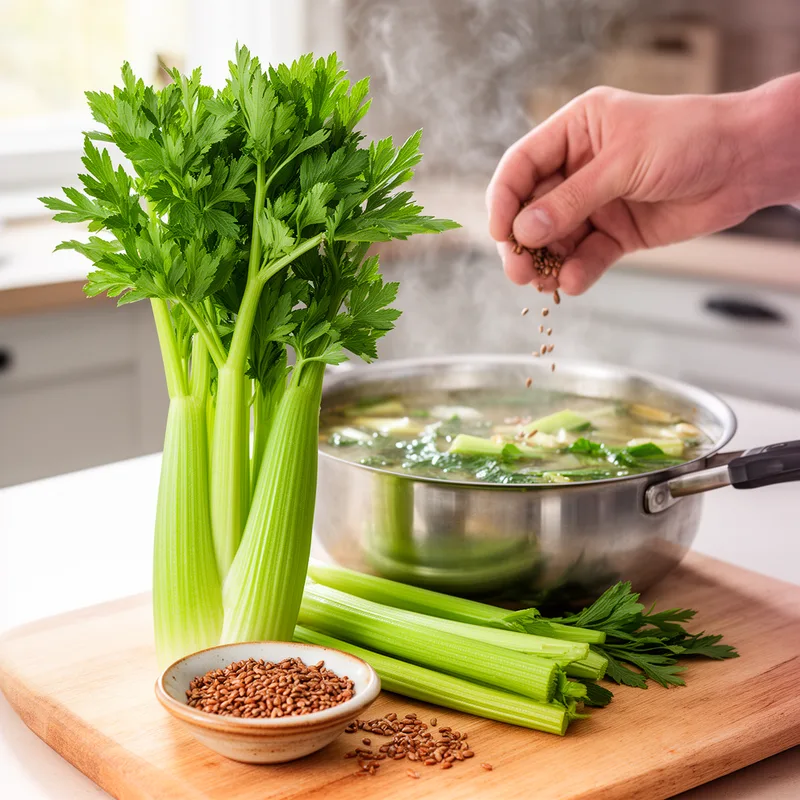
Levisticum officinale
- noun
- Specialized
- Gardeners often grow Levisticum officinale for its aromatic qualities and medicinal uses.
Examples
-
The leaves of Levisticum officinale can be used as a flavorful herb in soups and stews.
-
I love adding Levisticum officinale to my soups.
-
Cooks sometimes substitute celery with Levisticum officinale in traditional European recipes.
-
Have you ever tried Levisticum officinale in your dishes?
-
The herb Levisticum officinale is often used in soups and salads for its strong flavor.
-
She added fresh Levisticum officinale leaves to the sauce for an aromatic taste.
-
In the garden, Levisticum officinale grows well alongside other herbs and vegetables.
Synonyms


 1
9.7
1
9.7
A tall herb whose parts add flavour to food
Surface Forms
Morphology
This is a Latin botanical binomial: knowing 'Levisticum' as a genus name and 'officinale' as an adjectival form indicating medicinal use lets a learner infer it is a plant with medicinal associations, but it does not supply the common name (lovage) or the specific edible-stalk/leaf/seed usage. Because the genus label is an arbitrary taxonomic label and the full lexical referent requires botanical or cultural knowledge, the meaning is only partially derivable from the parts.
Etymology
Levisticum officinale may come from a place name and a word for medicine: Levisticum probably comes from 'Liguria', a region where the herb grew, and officinale was used for plants sold in old 'medicine shops'. That's why the name points to a common kitchen and medicinal herb, the one we now call 'lovage'.