
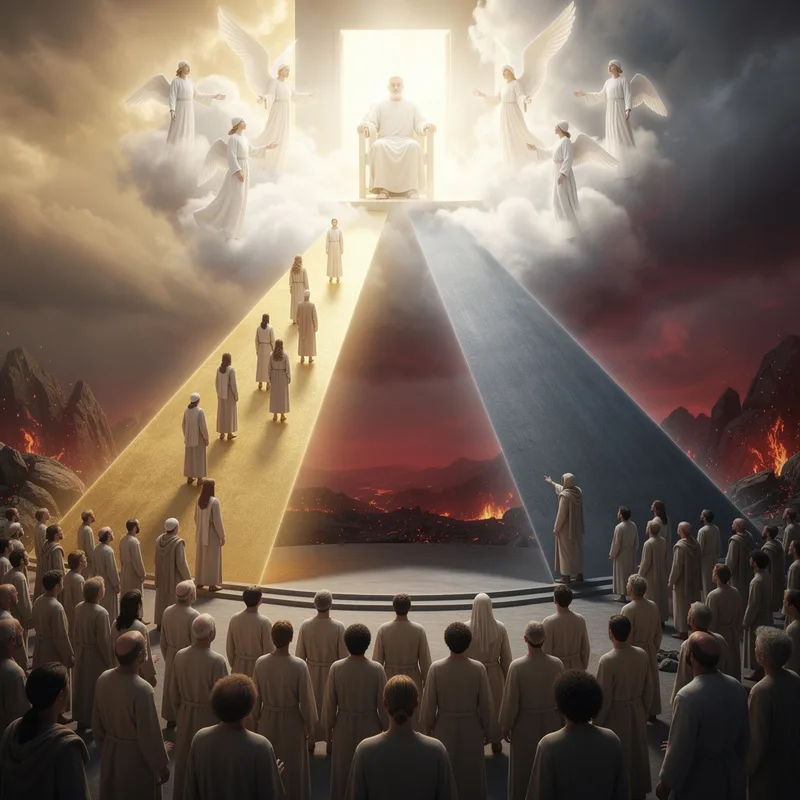
Last Judgment
 2
9.3
2
9.3

- noun
- /læst ˈdʒʌdʒmənt/
- Literature
- In Christian belief, the bodily resurrection of believers does not occur until the last judgment.
- Last Judgment scenes
- image of the Last Judgment
Loading YouTube…
Watch on YouTubeThere will be bodies after the last judgement in heaven and in hell.
- There will be bodies after the last judgement in heaven and in hell.
Examples
-
Fundamentalists, finally, are committed to an apocalyptic vision of the end of the world and the Last Judgment.
Academic text (2006) -
In the Christian imagination, the moment of death was an exact reflection, in miniature, of the terror of the Last Judgment.
Academic text (2008) -
So, even now they desire nothing else for themselves, and after the last judgment, they will desire nothing more at all.
Academic text (2008) -
This one had a before and an after, the Last Judgement here above and The Plains of Heaven below.
-
Brown sees the moment of death in early Christian belief as a reflection of the Last Judgment.
Academic text (2008) -
Significantly, the scene depicted within the frame is The Last Judgment.
Academic text (2002) -
Only the saints and the damned are up there between the stone windows in the grand Last Judgment.
Fiction book (1997) -
Rogier van der Weyden's Last Judgment Altarpiece is often cited as the source for the Gdansk Triptych.
Academic text (1991) -
According to Christian teachings, the Last Judgment will determine the eternal fate of every human being.
-
Many believers hope for mercy on the Last Judgment, trusting in God's forgiveness for their sins.
Synonyms
 50
7.9
50
7.9
The final event when God judges all people and decides their eternal fate
 23
7.5
23
7.5
The last day when the world ends or everything is destroyed
 19
8.8
19
8.8
In Christian belief, a future day when God judges everyone's life and decides their final place after death
 16
8.7
16
8.7
A day at the end of time when God judges everyone for their actions
 9
7.4
9
7.4
The return of Jesus Christ to earth to judge people at the end of the world
 7
8.6
7
8.6
A future day when God judges people and decides if they go to heaven or hell
 1
6.8
1
6.8
Christians believe Jesus will return to earth to judge people
 1
9.9
1
9.9
A final event in Christian belief when God ends the world


 1
8.7
1
8.7
A future day when God judges everyone for their actions
 1
9.9
1
9.9
The return of Jesus Christ to earth to judge all people
 1
9.0
1
9.0
A time when someone must face the results of their past actions
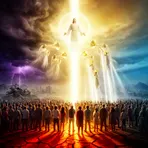
The day when God judges everyone and the world ends
How Final
- Literature
2
9.3

- Literature
1
9.0
- Literature
42
7.0
874
4.1
∞
1.0
Surface Forms
Morphology
last + Judgment
The meaning 'the final day when God judges humans' is directly inferable from 'last' (final) combined with 'judgment' (an act of judging or decision). This compositional reading is cross-linguistically common (e.g. ‘Final Judgment’/‘Day of Judgment’) and follows normal English noun-noun semantics, so a B1 learner who knows both constituents would very likely deduce the MWE's meaning.
Etymology
The phrase Last Judgment comes from Christian stories of the end of the world, where God sits and decides who is saved or punished. The word last shows it is the final day and judgment shows the deciding of right and wrong, so the phrase means 'the final day when God judges all people'.