

Indian paintbrush


 1
6.8
1
6.8
- noun
- /ˈɪndiən ˈpeɪntˌbrʌʃ/
- US
- The trail itself was lined with the tiny red flowers of Indian paintbrush.
- Indian paintbrush and bluebonnet
- Indian paintbrush and lupine
- Indian paintbrush and columbine
Examples
-
Black-eyed Susan in the meadows, Indian paintbrush by the road, lady's slippers in the shady spots.
Fiction book (1995) -
"Let's go a little farther; I know where there are Indian paintbrushes blooming still."
Fiction book (1991) -
"This is Indian paintbrush, and this pink one is mountain hollyhock."
Fiction book (1996) -
Indian paintbrushes, evening primroses, bluebonnets, and a dozen other species arrived one after the other.
Blog text (4) -
Behind the house stretched a field of wildflowers—the usual bluebonnets and Indian paintbrushes, but in the center was the densest stand.
Fiction book (1995) -
Everywhere, winter's waned snowbanks had given rise to galaxies of buttercups, columbine, larkspur, and Indian paintbrush.
Fiction book (2001) -
Next year the brambles would take it; but now it blazed with goldenrod, Devil's paintbrush, the luminous blue of chicory, and the biggest Indian paintbrush flowers Janet had ever seen.
Fiction book (1991) -
The trail itself was lined with the tiny red flowers of Indian paintbrush.
-
In April and May, the Hill Country surrounding Austin is abloom with bluebonnets, red Indian paintbrush, and pink primroses.
-
To the south lay a vast field of bluebonnets and Indian paintbrush in full Texas glory.
Synonyms

Plants from the western Americas that often take food from grass roots and have bright red or orange flowers
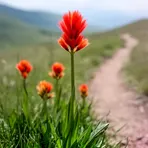
A wild plant with bright red or orange flower parts that look like a brush
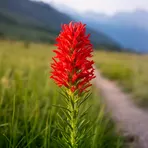
A wildflower with bright red, ragged flower clusters that grows in western North America

A plant with tall stems and dense bright red or orange flower spikes
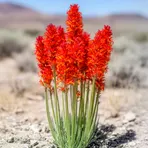
A plant in dry western United States areas with straight stems and groups of bright red and orange flowers
Surface Forms
Morphology
Indian + paintbrush
The compound provides partial cues: 'paintbrush' evokes the tool’s shape, so a learner could guess the referent is something shaped like a paintbrush, and 'Indian' signals a cultural/geographic association. However the precise meaning—that it is a specific wild North American flowering plant (not an actual paintbrush or an object from India)—is not fully predictable from the parts and can easily be misinterpreted, so the expression is only partially transparent to a B1 learner.
Etymology
Indian paintbrush comes from the flower's look: its bright red or orange parts spread out like a small paintbrush dipped in paint, and early observers compared this to brushes used by Native American artists. So today the name helps people remember a 'plant with bright, brush-like flowers'.