
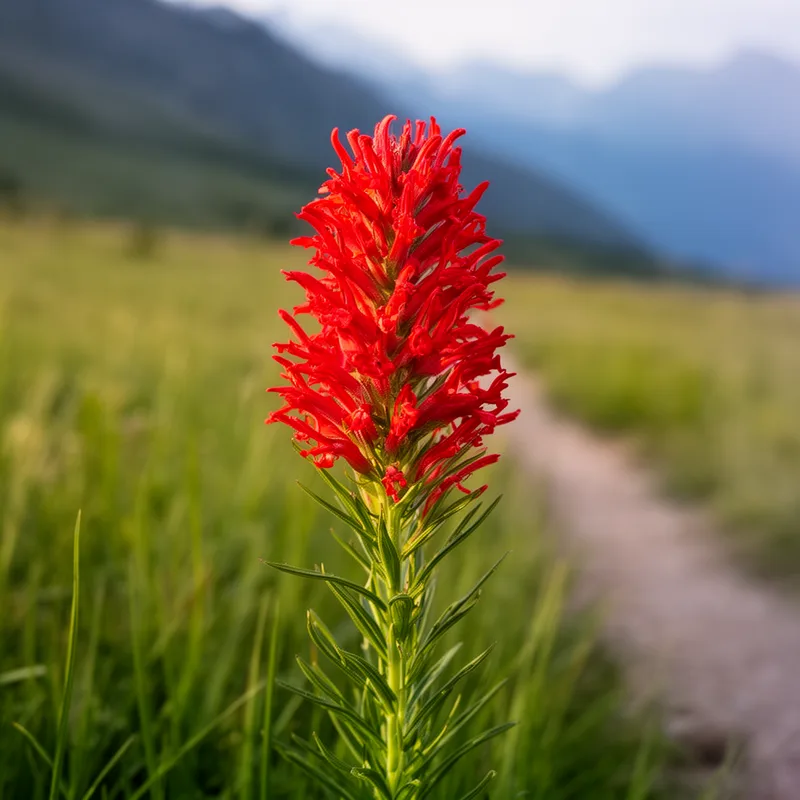
Castilleja miniata
- noun
- Specialized
- The brilliant red of the Castilleja miniata stood out among the green grasses of the meadow.
Examples
-
We saw a patch of Castilleja miniata blooming along the mountain trail.
-
The Castilleja miniata blooms brightly in the summer.
-
Many photographers are drawn to fields where Castilleja miniata grows in abundance.
-
Have you seen a Castilleja miniata in bloom?
-
Many photographers are drawn to fields where Castilleja miniata grows in abundance.
-
The brilliant red of the Castilleja miniata stood out among the green grasses of the meadow.
-
We saw a patch of Castilleja miniata blooming along the mountain trail.
Synonyms


 1
6.8
1
6.8
A wild plant with bright red or orange flowers found in North America

A wildflower of western North America with ragged clusters of bright red flowers
A wild plant with bright red or orange flower parts that look like a brush
Surface Forms
Morphology
Castilleja + miniata
This is a Latin binomial: knowing 'Castilleja' as a flowering-plant genus lets a learner infer the phrase denotes a species of that genus, so the taxonomic relation is transparent. However, 'miniata' is a Latin epithet (not a common English word) and its specific descriptive sense (e.g., red/scarlet) is not recoverable by a B1 learner, so the overall meaning is only partially predictable.
Etymology
Castilleja miniata may come from the genus name Castilleja, given for a Spanish plant scientist, and the species word miniata, which means 'painted red'. The flower's bright red parts look like a paintbrush dipped in paint, so people call it the 'Indian paintbrush', and that image explains the name for this red wildflower today.