
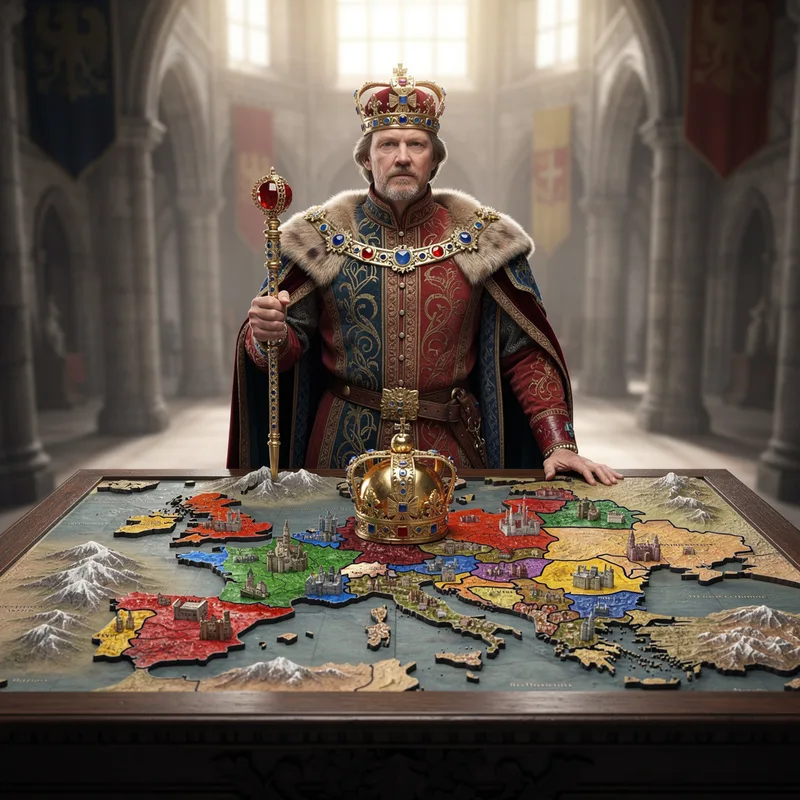
Holy Roman Empire
 2
8.4
2
8.4

- proper noun
- Charles V ruled over the territories of the Holy Roman Empire during the 16th century.
Loading YouTube…
Watch on YouTubeNow, the, the the Holy Roman Empire was in certain respects an elective monarchy.
- Now, the, the the Holy Roman Empire was in certain respects an elective monarchy.
- But Rome didn't really die at that point either because you still had in the West the continuation of what they called the Holy Roman Empire.
Examples
-
The Holy Roman Empire was a significant political entity in Europe from 962 until 1806.
-
Charles IV takes the throne and makes Prague the capital of the Holy Roman Empire in 1348.
Academic text (2005) -
Professor at Charles University, which was the first university to be established in the Holy Roman Empire, as you know.
Fiction book (1996) -
Charles V, emperor of the Holy Roman Empire
Fiction book (1998) -
But Charles V, ruler of the Holy Roman Empire, is the top political power.
Fiction book (1998) -
In 1521, Luther was called before leaders of the Holy Roman Empire.
Fiction book (1998) -
The region split into a patchwork of Lutheran and Catholic principalities as the Holy Roman Empire, for the first time in its history, gradually accepted the idea of a competing faith.
Academic text (1998) -
Transylvanian Saxons originated in twelfth-century migration from the Holy Roman Empire, attracted by offers of privileges to economically productive settlers.
Academic text (2016) -
Although the Papacy and feudal aristocracy retained some power, after Westphalia the Holy Roman Empire's ability to enforce its ecclesiastical and political hegemony was virtually destroyed.
Academic text (2005) -
The Treaty of Westphalia ended conflicts involving the Holy Roman Empire in 1648.
Synonyms

 1
9.9
1
9.9
A name for the Holy Roman Empire as the first of three German empires
Surface Forms
Morphology
The parts 'holy' + 'Roman' + 'empire' give a fairly clear general idea — a sacred or church-related empire associated with Rome — so a learner who knows the words can infer it denotes a specific kind of empire. However, the full historical referent and the misleading sense of 'Roman' (the polity was a medieval, largely Germanic entity rather than the ancient Roman state) require background knowledge, so the meaning is not fully predictable from the constituents alone.
Etymology
Holy Roman Empire got its name because rulers wanted to show their rule was tied to the church, so Holy, and that they claimed the old Roman past, so Roman. So the name tells us it was an empire that mixed church power and the idea of ancient Rome.