
Helianthemum canadense
- noun
- /ˌhiːliˈænθəməm kəˈnædɛnz/
- Specialized
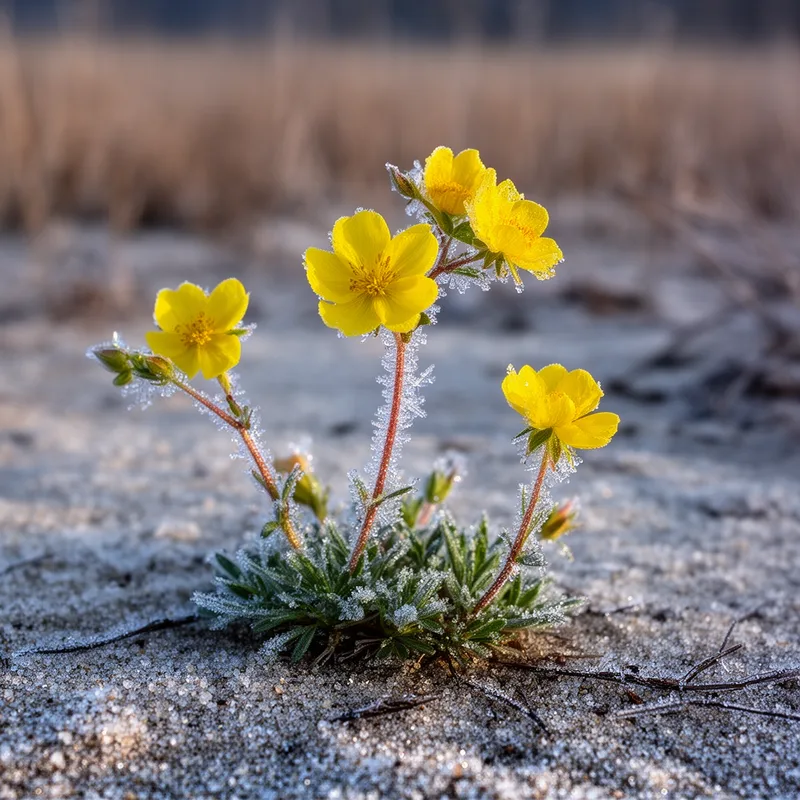
- The delicate stems of Helianthemum canadense glisten with frost crystals on cold autumn mornings.
Examples
-
In spring, Helianthemum canadense covers dry, sandy soils with bright yellow flowers.
-
Many gardeners appreciate Helianthemum canadense for its vibrant yellow flowers.
-
Botanists study Helianthemum canadense for its unusual response to the first frosts of the season.
-
The Helianthemum canadense blooms beautifully in early spring.
-
In spring, Helianthemum canadense covers dry, sandy soils with bright yellow flowers.
-
The delicate stems of Helianthemum canadense glisten with frost crystals on cold autumn mornings.
-
Many gardeners appreciate Helianthemum canadense for its vibrant yellow flowers.
Synonyms

A plant that makes thin ice ribbons on its stems during first frosts and has yellow flowers
A North American plant with early yellow flowers that forms ice crystals on its stems in frost

A plant that lives many years, makes early yellow flowers, and gets ice crystals at first frost
Surface Forms
Morphology
Helianthemum + canadense
This is a Linnaean binomial: a genus name plus a Latin specific epithet. If a learner knows 'Helianthemum' as a flowering shrub and recognises 'canadense' as deriving from 'Canada' (Latin/formation meaning 'of Canada'), then the meaning 'the Helianthemum species from Canada' is recoverable. However, the Latinized epithet and the convention of scientific names are not part of everyday English composition, so the inference requires extra morphological or botanical knowledge and is not fully transparent to a typical B1 learner.
Etymology
Helianthemum canadense comes from the parts Helianthemum, meaning 'sun' and 'flower', and canadense, meaning 'from Canada'. Its small yellow flowers look like little suns on low stems that often have frost in the first cold days, so the name gives a simple picture of the plant and where it grows.

