
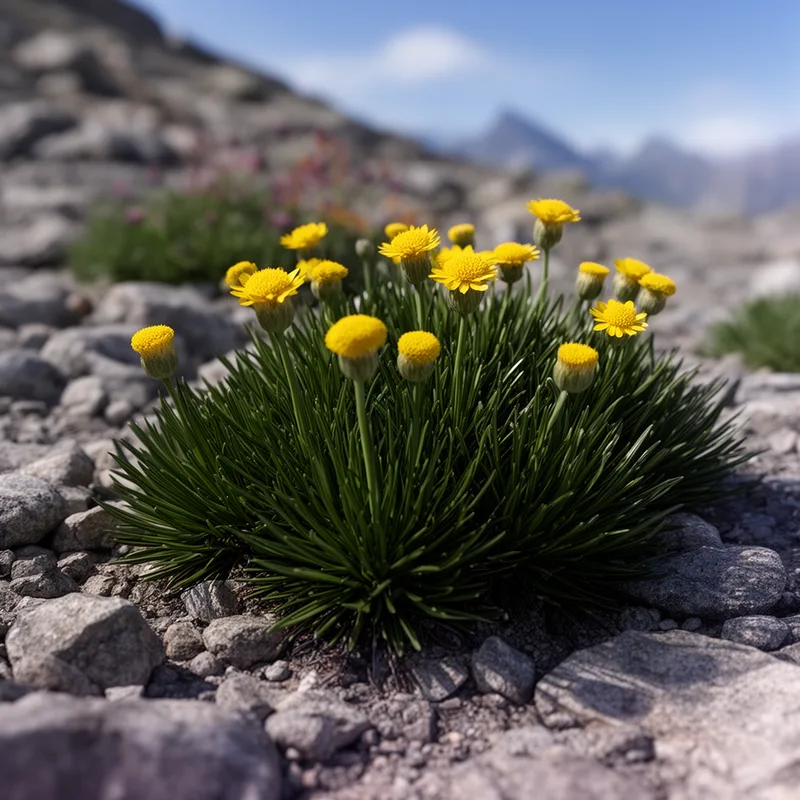
Haplopappus acaulis
- noun
- Specialized
- The stiff, tufted leaves of Haplopappus acaulis help it survive harsh mountain climates.
Examples
-
Haplopappus acaulis is known for its vibrant yellow flowers that attract pollinators.
-
Haplopappus acaulis grows in rocky soils and blooms in late summer.
-
Botanists recently reclassified Haplopappus acaulis based on new genetic evidence.
-
The Haplopappus acaulis thrives in rocky soils.
-
Have you seen the Haplopappus acaulis blooming this spring?
-
In the wild, Haplopappus acaulis typically grows among other native plants in the dry, rocky terrain.
-
Many gardeners appreciate Haplopappus acaulis for its drought resistance and unique foliage.
Synonyms

A small green plant with stiff leaves in clumps and bright yellow flowers that grows in western North America

A dark green herb that grows in stiff clumps and has yellow flower heads
Surface Forms
Morphology
Haplopappus + acaulis
This is a taxonomic binomial: combining the genus name 'Haplopappus' with the specific epithet yields a species name, so at a basic referential level a learner who knows the constituents would recognize it as a particular Haplopappus. However, the epithet 'acaulis' is a Latin botanical term (not a common English word) and the detailed descriptive meaning in the dictionary entry (the plant's morphology) is not fully derivable by an average B1 learner, so the transparency is only partial.
Etymology
Haplopappus acaulis comes from Greek and Latin parts: haplo- meaning 'simple' or 'single', pappus meaning a tuft of hairs on the seed, and a- with caulis meaning 'no stem' or 'stemless'. So the name paints a clear picture of a low, almost 'stemless' herb with dense leaf tufts and simple seed tufts, which is why it suits this small mountain plant.

