
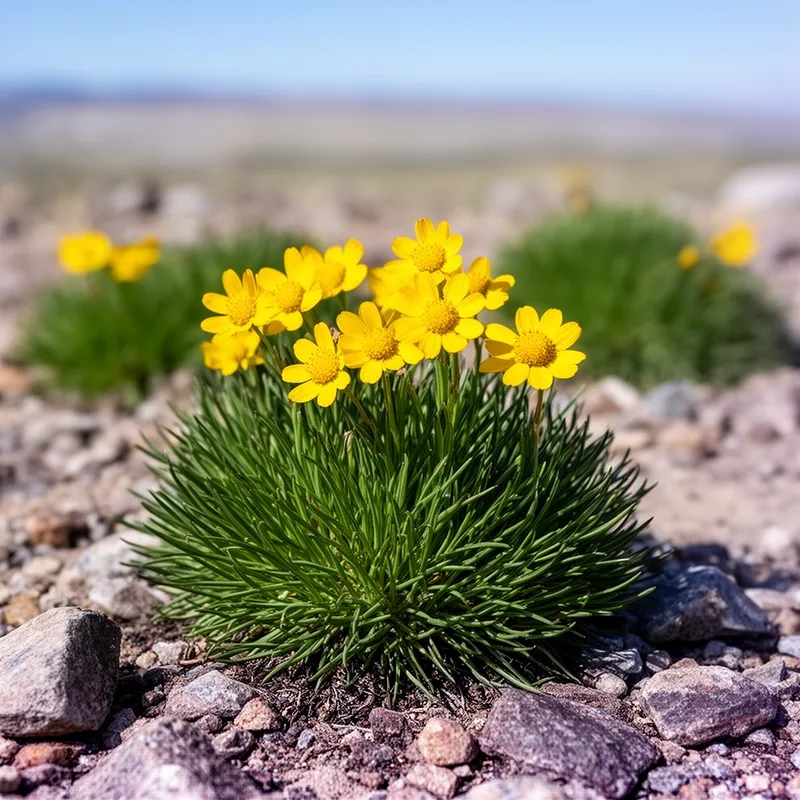
Stenotus acaulis
- noun
- Specialized
- The botanist identified the small tufts as Stenotus acaulis during her field survey in Montana.
Examples
-
Many gardeners appreciate Stenotus acaulis for its drought tolerance and sturdy foliage.
-
Stenotus acaulis thrives in rocky, open areas across the western states, displaying clusters of bright yellow flowers.
-
The Stenotus acaulis thrives in rocky soils.
-
Have you seen the Stenotus acaulis blooming?
-
Stenotus acaulis is commonly found in the mountainous regions of the northwestern United States, showcasing dense tufts of yellow flowers.
-
In the wild, Stenotus acaulis can often be seen growing among rocks, its sturdy leaves providing a striking contrast against the landscape.
-
Botanists often study Stenotus acaulis for its unique adaptations to harsh environments and its vibrant flower heads.
Synonyms

A dark green mountain plant with stiff leaves that grow in small clumps and yellow flower heads

A dark green herb that grows in stiff clumps and has yellow flower heads
Surface Forms
Morphology
Stenotus + acaulis
This is a Latin binomial (a taxonomic species name) rather than a compositional English phrase, so its specific meaning (a particular plant species with certain features) cannot be derived by a B1 learner from ordinary constituent words. The elements are technical/Latin (with 'acaulis' not glossed here), and even knowing 'Stenotus' as a genus does not let a learner predict the species' properties, making the expression non-compositional for typical learners.
Etymology
Stenotus acaulis comes from Latin. The word acaulis means 'without a stem', so imagine a small plant whose leaves and flowers sit right at ground level. That image explains why the name describes a low, stemless herb.

