

Gregorian chant
 2
9.5
2
9.5

- noun
- /ɡrɪˈɡɔːriən tʃænt/
- The general music class of listener-detectives had heard a Gregorian chant, followed it in the score, and checked off the music as it progressed.
- listen to Gregorian chant
- sing Gregorian chants
Examples
-
A student who listens to Gregorian chant to recognize the language, the historical context, and the style will love it.
Academic text (1994) -
Through it all, I knew that in Gregorian chant I had found the native tongue of my soul.
Blog text (28) -
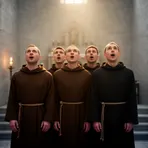
All of them are singing a Gregorian chant.
Fiction book (1992) -
A student who listens to Gregorian chant only to determine whether he or she likes it will hate it.
Academic text (1994) -
Even many who are not Catholic or even theists enjoy Gregorian chant and Catholic polyphony.
Blog text (32) -
Exposition of the Holy Sacrament followed Mass, so a sheet with a lengthy Gregorian chant in Latin was distributed.
Blog text (10) -
The silence of that huge space was broken only by a Gregorian chant sung by the priests in this cathedral built at the heart of a mosque.
Academic text (2011) -
For example, "Ere the World Began to Be," by Jack Stamp, was based on a Gregorian chant, so students learned about chants and wrote their own chants.
Academic text (2005) -
Pope Benedict, speaking on liturgical music and the new evangelization, emphasizes Gregorian chant, polyphony, and listening.
Blog text (32) -
The choir performed a beautiful Gregorian chant during the evening service.
Synonyms
 58
3.9
58
3.9
A simple repeated song sung on one note, often in religious ceremonies
 4
2.3
4
2.3
Music sung or played during Christian services

 1
9.9
1
9.9
A church song with one simple tune that people sing without instruments

People sing words from a holy text in a religious service using a traditional tune
Surface Forms
Morphology
The compound directly combines 'Gregorian' (pertaining to Gregory I or the Gregorian tradition) and 'chant' (a monophonic religious song), so its meaning — a chant associated with Gregory/the Gregorian liturgical tradition — is derivable from the parts. It is a somewhat specialized historical term, but the compositional relation is clear to a learner who knows both constituents.
Etymology
The name Gregorian chant may come from Gregorian, the name of Pope Gregory I, because one popular story says he helped put together the church songs long ago. The word chant means simple singing by monks without instruments, so today Gregorian chant refers to the calm, 'sacred' songs still sung in church.