

Gregorian


 1
8.6
1
8.6
- adjective
- /ɡrɪˈɡɔriən/
- Also, the Holy Father urged them not to be afraid of the treasury of the Church's sacred music, especially Gregorian chant and polyphonic music.
- Gregorian chant
Examples
-
In order to lead all these magnificent young singers and Gregorian chants, I had to learn the Gregorian chants.
-
The silence of that huge space was broken only by a Gregorian chant sung by the priests in this cathedral built at the heart of a mosque.
Academic text (2011) -
We're going to begin here with Gregorian chant talking about the traditional music of the Roman Catholic Church.
-
And she really kind of sounds like she's doing a Gregorian chant.
-
A type of Gregorian chant that is characterized by the presence of melismas.
Academic text (2003) -
It sort of flows gently, like Gregorian chant.
-
Sir, the song of your generation is Gregorian Chant Deus Eire.
-
For example, since the Bukvich composition was based on a neo-Gregorian motif, students listened to authentic Gregorian chant and looked at samples of Gregorian notation.
Academic text (2005) -
A Gregorian chant can, for many, send a shudder up the spine, but in the richly symbolic space of the Cathedral-Mosque, the chant I heard there was unlike any other.
Academic text (2011) -
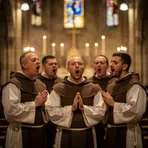
The choir performed a beautiful Gregorian chant during the mass.
Compounds
 2
9.5
2
9.5
A sacred song of one melody that people sing with voices and no instruments in the Catholic Church


- Specialized
A musical scale used in old church singing that gives chants a special sound

- Specialized
A telescope that uses two curved mirrors to focus light back through a hole in the main mirror
Surface Forms
Morphology
Gregorian = Gregory (semi-transparent) = Gregory + an
Formed regularly from the proper name 'Gregory' plus the productive adjectival suffix '-an', but the specific historical referent (Pope Gregory I) and the specialized meaning 'plainchant' require extra knowledge.
Etymology
Gregorian comes from the name Gregory, after Pope Gregory I, who people long thought arranged the old church plainchant; so Gregorian chant means the ancient church music linked with him.