
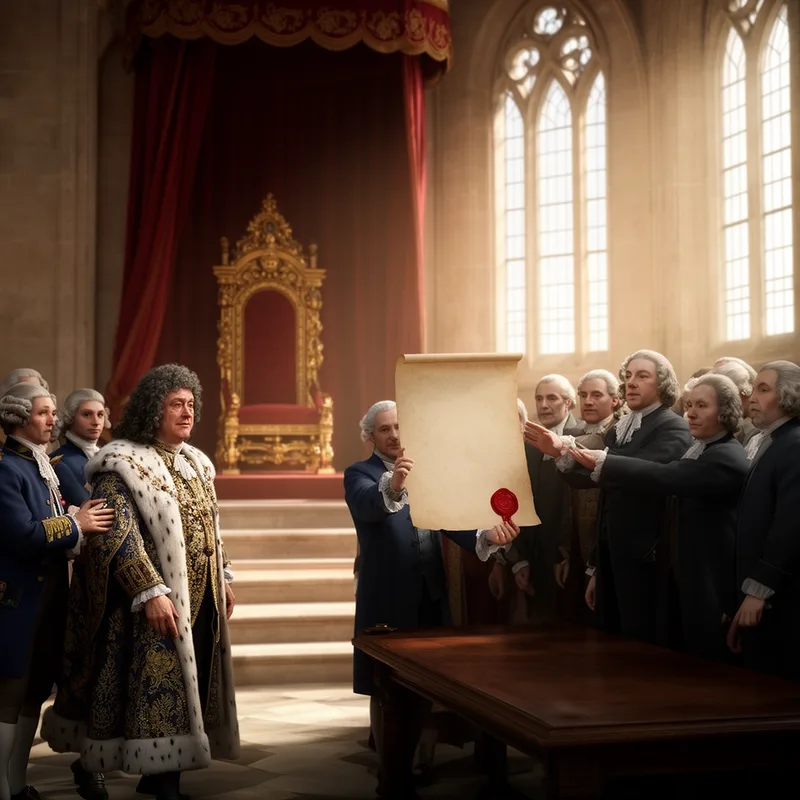
Glorious Revolution
- proper noun
- Locke's political ideas are found in his Two Treatises of Government, which justified the Glorious Revolution in England of 1688.
- the Glorious Revolution of 1688
Examples
-
Many historians consider the Glorious Revolution a pivotal moment in British history for its impact on governance.
-
Jefferson, comparing the American Revolution to the Glorious Revolution, remarked that "Our Revolution commenced on more favorable ground."
Blog text (34) -
The first derives from the Glorious Revolution of 1688.
Blog text (17) -
The Glorious Revolution of 1688 followed in England soon after, and the alliance between church and state weakened as the Anglican Church lost some power.
Academic text (2007) -
England's Glorious Revolution of 1688-89 was critical to the development of modern liberalism because it first established the constitutional principle that the state could not legitimately tax its citizens without their consent.
Academic text (2012) -
The Framers followed the eighteenth-century English practice, which developed in the wake of the Glorious Revolution of 1688, of securing judicial independence through life tenure in office for judges.
Academic text (2006) -
As late as 1753, the people of Charles Town still gathered for "the Anniversary of our happy Deliverance from a most horrid Popish Plot, and of the glorious Revolution by the landing of King William in England," though the newspaper only noted that the "Day was observed here as usual."
Academic text (2007) -
The Glorious Revolution of 1688 marked a significant shift toward parliamentary supremacy in England.
-
In the Glorious Revolution, King James II was overthrown, establishing the foundation for limited monarchy.
Synonyms


 1
6.1
1
6.1
A 1688 change in England's rulers that made William and Mary king and queen

The change of rulers in 1688–1689 that puts William and Mary on the throne with little violence
Surface Forms
Morphology
The words 'glorious' and 'revolution' transparently convey the idea of a celebrated or significant overthrow, so a learner who knows both constituents can infer it refers to an important political change. However, as a capitalized proper name for a specific 1688–89 historical event (the overthrow of James II and the establishment of parliamentary supremacy), the precise referent and historical implications are not predictable from the parts alone, so prior knowledge is required.
Etymology
The Glorious Revolution got its name because it was a big change of rulers in 1688–89 with very little fighting: William of Orange was invited to take the throne and King James II fled. Because this event gave more power to Parliament and limited the king, people called it a glorious revolution, so today the name means that mostly peaceful overthrow that changed Britain’s government.